The Environment Caretaking Initiative
Approx. 20,000 words - Reading time: 3-4 hrs First Posted: July, 2023 Last update: April, 2025
Configured to be viewed on laptop or desktop
Split-screen recommended to view the diagrams alongside the text

HOLD ON GUYS.!!!
I think we’re fighting the wrong dragons!
Re-examining how we take care of our precious little planet
Yes, the earth does seem to be warming up - but is it an imminent threat to life on earth..? Is it really because of Carbon Dioxide..? And if our planet is feeling a little under the weather, is there anything we can do to nurse it back to health..? Is a change of prescription in order..?
Preface
Countless factors and feedback loops affect the world’s climate and the weather; present day computer models simply cannot duplicate “the real thing” with any degree of accuracy. There are just too many unknowns and unpredictable variables. Asserting we can predict (and even control) the planet’s average temperature decades ahead down to a fraction of a degree, based on a few assumptions and a very shaky hypothesis (namely that carbon dioxide is the main - if not the only - driver of climate change), is highly presumptuous at best.
Still, the matter of climate change does need to be addressed since it has become one of the dominant scientific and policy issues of our time. We need to get a better understanding of how humanity, the climate, and nature all mesh together. We need to get to the core of the issue.
The following is my take on the subject - my small contribution to the debate. There are no new facts here, no earth-shattering discoveries. It’s that after years ruminating on it and keeping an eye on the arguments from both sides, I couldn’t shake away the uneasy feeling that something wasn’t right, that we’re missing something here. So I decided to wipe the slate clean, put aside the assumptions, and try to paint the “big picture” with know facts - sort of like “paint by numbers” - something we geologists like to do.
This essay is not a compilation of various views found online or from AI; it’s based on well established scientific principles, facts, and recent findings - I simply followed the bread crumbs - they led me well off the beaten path…
I don’t claim to have all the answers, my aim here is to point things in a different direction for others (especially scientists in various disciplines) to ponder. I welcome any thoughtful feedback - from scientists and laypersons as well (comment form below). Note that this is, and will remain, a work in progress - frequently updated. I thank those who have contacted me so far with thoughtful comments and suggestions.
“JC” Gobeil - Retired Geologist - Canada
It’s “complicated”
As opposed to political decisions, scientific issues are not resolved by consensus; theories need to be supported by verifiable observations, and then go through a rigorous validation process before they can be accepted as scientific facts. With regards to the climate, when all hypotheses have been honestly and openly analyzed and tested, maybe then we can reach a consensus, and perhaps act on it. Suppressing information and ignoring opposing views is not science at all, it’s dogma - science is asking questions; it’s a perpetual process of seeking better understanding. I’m very concerned about the direction Western leaders have taken.
And as for “vested interest” accusations routinely aimed at “deniers” (especially those linked in some way to the oil industry), consider the fact that there’s considerably more funding (and jobs) available to “believers”, and organizations that “go along” with the prevailing political narrative – so who’s interest is most “vested”..?
Here’s a thought from Dr. John Clauser (the latest Nobel Prize laureate to sign the World Climate Declaration): “Beware. If you’re doing good science, it may lead you into politically incorrect areas.”
Judith Curry, well known and respected American climatologist, and author of Climate Uncertainty and Risk, testified to the United States Congress that “There is so much uncertainty about natural climate variation that trying to reduce emissions may be pointless.”
This essay is aimed primarily at those who are somewhat scientifically minded; but I feel anyone who’s interested will see what I’m getting at (even if some sections may seem a little “heavy”). How we deal with this issue affects us all - financially, socially, politically, even emotionally - and those of us who care, those who can help, should not hesitate to step up to the plate and get involved. I strongly believe we need a course correction.
For those who may want to “dig into this” a little deeper, I’ve included links to a few relevant web pages. You might also find Wien’s Law Calculator and the everythingRF Calculator useful for temperature-frequency equivalents, and to make conversions related to radiant emission.
I don’t get into formulas here – math is not my strong suit anyway – but remember, when evaluating other viewpoints, that formulas, calculations, or fancy diagrams are only as valid as the hypothesis and facts they’re based on; otherwise, it’s just window dressing. And as for computer climate models, I advise caution – there’s still a lot of work to be done on the “inputs” and the programing before we can trust the “outputs” (not to mention the common practice of “tuning” the results to fit the assumptions). For now, we should do more thinking and less computing. Hopefully, as we gain a better understanding of the processes involved, and as computers become more powerful, their “predictions” will be more reliable; but when it comes to the climate, there will always be a healthy dose of uncertainty. For an expert’s take on computer modeling, and a dispassionate “untangling” of the complex world of politics and science when it comes to “climate issues”, along with a few common sense suggestions, I highly recommend “Unsettled” by Steven Koonin - a must-read for anyone seriously interested in the subject.
There are several naturally occurring cycles that affect the climate, and just like waves in the ocean, occasionally two or three of them may get in phase and cause a “rogue” wave - those are nearly impossible to predict - but we can predict with some degree of accuracy the average height of waves given a certain wind speed, time, and distance, because we know that, when it comes to waves, the wind is the driving force. When it comes to the climate, the driving force is primarily solar energy. We need to figure out what controls the flow of that energy to and from the planet’s surface, and which mechanism, if any, is predominant. We have NOT done that conclusively. Once we have figured that out, not only should long-term climate forecasting improve, it’s possible we may be able to actually have some measure of control over it.
Most of the graphs/sketches here are originals; others are modified graphs found online. All are based on information gathered from various sources that I believe to be reliable. Note that the farther back in time we go, the greater the margin of error.
________________________
Sections
1) Is there really a problem with the climate..?
2) How the atmosphere affects temperature…
3) What about Carbon Dioxide..?
4) If it’s not CO2, what else could it be..?
5) Human activities and climate change…
6) Roadmap to a promising future…
________________________
Introduction
We live on a beautiful and unique planet that’s full of life – in some places it can take your breath away… It took billions of years for the earth to reach this stage. First, it had to cool from its fiery origins down to temperatures that would allow for the formation of oceans and emergence of life; then it had to settle within a relatively narrow range for hundreds of millions of years for life to take hold and evolve to where it is now (as we’ll see later, it’s not a coincidence that global temperatures began to stabilize after the formation of oceans). The landscape, the forests, the seas, the biodiversity, everything around us is amazing - an incredible gift; nothing short of a miracle! We really need to appreciate that; also we should not lose sight of the fact that we humans are an integral part of it all, and acknowledge that what we have managed to accomplish in such a short time is impressive on many levels: philosophical, artistic, scientific, technological... But we must make sure we’re not doing something that’s putting all of it at risk… It’s INCREDIBLY precious, and it’s all we have!
If we can determine that there is a serious problem with the climate, or with the biosphere itself, and that it’s anthropogenic (caused by humans), then we’d better do something about it. But first, it’s important to make sure that we’re right, that we have correctly identified the problem, its severity, and the actual cause, before pouring money and resources at correcting it. If we get it wrong, we may not have a second chance!
Regrettably, in the late 1900’s, the old (and unproven) theory that “man-made” CO2 is causing the earth’s temperature to rise abnormally was given new life with the publication of Michael Mann’s “hockey stick graph”. It was picked up by the Intergovernmental Panel on Climate Change (IPCC) a few years later, and it was assumed that the temperature uptick was caused by man-made Carbon Dioxide. This was then popularized with Gore’s “An Inconvenient Truth”. That sparked a severe outbreak of groupthink: “We are heading straight into a climate apocalypse; and we know for sure that man-made carbon dioxide (read “fossil fuel”) is the villain.” Case closed. No questions. No discussion.
Ever heard that little piece of insight from Mark Twain..? “What gets us into trouble is not what we don’t know; it’s what we know for sure that just ain’t so.” Al Gore (who BTW didn't do well in science classes) quotes it in his documentary” - somewhat ironic.
Nearly everyone jumped on the bandwagon – intellectuals, politicians, journalists, celebrities, and educators fervently spread the anti-carbon gospel, and it soon became a major political issue throughout North America and Europe - “the Left” (starting with Al Gore, Obama, and John Kerry) saw it as a golden opportunity to tighten their grip on the populace, and launched their crusade to “save the planet”. Although not scientists themselves, they declared the science “settled” - and made it their mission to discourage, ridicule, block, shadowban, or somehow silence anyone with a different viewpoint. To dare question the orthodoxy, to be labeled a “climate denier” or “skeptic”, or to be accused of “spreading misinformation” or of “pushing conspiracy theories” could spell the end of one’s career. Result: Most meaningful discussions and alternative viewpoints have been effectively suppressed, and a growing tendency (even by respectable institutions) to make the science fit the narrative (Integrity is often the first casualty of funding or peer pressure). Claiming the science has been settled has also had the unfortunate effect of discouraging meaningful research.
“But 97% of scientists agree!” they all claim. And they keep repeating it over and over again like a mantra, as if that “proves” they’re right... That figure came from a poorly conducted study published in 2013 by John Cook (and then popularized by Obama). It has been used since then to intimidate those who, like me, might not agree. (For those interested, here’s a thoughtful review of John Cook’s report by Andrew Montford of The Global Warming Policy Foundation.) And maybe check out this to-the-point article by Ross McKitrick of The Fraser Institute, Canada’s top think-tank: “Putting the ‘con’ in consensus” - “Not only is there no 97% consensus among climate scientists, many misunderstand core issues”.
And consider this 2012 joint letter sent to NASA’s Administrator, signed by 49 former NASA scientists who are not convinced that CO2 is the main cause of climate change, and disagree with NASA’s official position on the matter. Excerpt: “There’s a concern that if it turns out that CO2 is not a major cause of climate change, NASA will have put the reputation of NASA, NASA’s current and former employees, and even the very reputation of science itself at risk of public ridicule and distrust”. That letter (and many other “non-conforming” opinions) has been largely ignored. A number of them and other retired NASA scientists have set up their own website with the express purpose of separating facts from fiction when it comes to “climate change”, and informing the public and policy makers.
Now, there is consensus among a wide majority of scientists that the planet IS warming up, and that human activities MAY be contributing to it; but still many questions remain unanswered… Is that warming putting life on earth at risk..? Is it primarily caused by an accumulation of CO2 in the atmosphere or by something else..? How much of it is anthropogenic..? Et cetera… The problem is that climate science one of the few areas of science that touches on nearly all scientific disciplines - and in today’s world, scientists tend to specialize - so the only way we’ll reach a reasonably good understanding of what drives the climate is if all scientists pitch in. “Climate science” or “climatology” as a formal field of study is still in its early stages of development, it’s a relatively new discipline - for example, there are only 7 small Canadian universities (less than 10%) offering Climatology courses/degrees in Canada. Much more data and more information is needed from established scientific fields (thermodynamics, quantum mechanics, fluid dynamics, chemistry, geology, oceanography, biology, computer sciences, etc.), and theories need to be validated before climate modeling can be trusted. Until then, Climatologists and Meteorologists are just groping in the dark - their conclusions and predictions re. climate can be nothing more than educated guesses.
So the science is far from “settled”. We’re nowhere near reaching “scientific consensus” on climate change and its causes - there are still too many unanswered questions, too many uncertainties. We’re only beginning to scratch the surface.
1
Is there really a problem with the climate..?
Is the temperature getting too high..? Is there a “climate emergency”..? Are sea levels rising too much..? There’s no simple answer. First, the climate has always changed; it changes from year to year, decade to decade, and century to century; it always has, it always will. The question is – is it now changing too much or too rapidly... and if it is, are humans causing it…
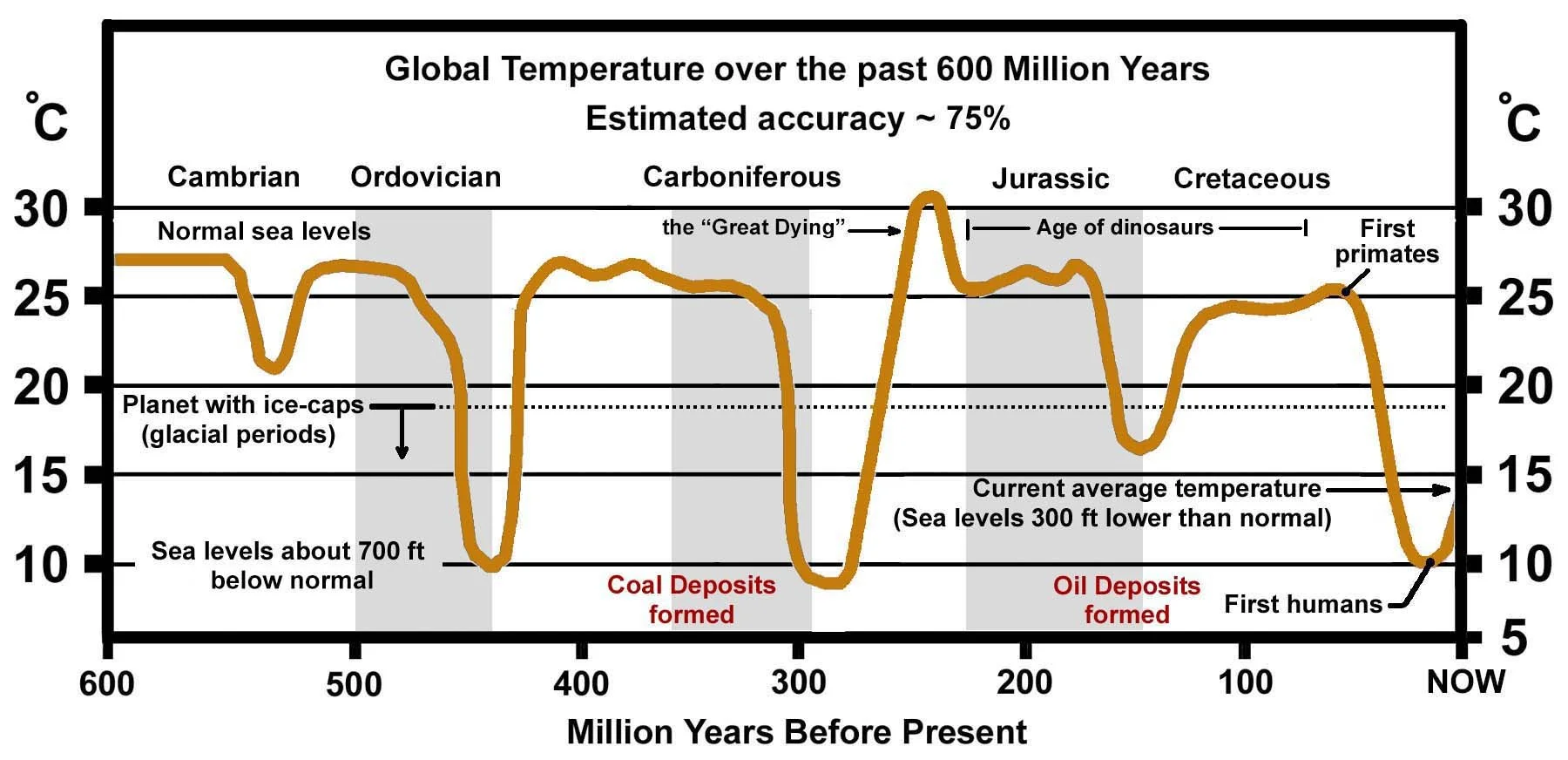
Let’s step back a little and take a look at the big picture: the past 600 million years of our geological past (BTW, you’ll find a number of similar graphs on the net – this is my own “best guess” rendition). Over that period, the average global temperature has ranged roughly between 10°C and 30°C, but 80% of the time it hovered around 25°C, much higher than it is today (14-15°C). Still, over the past 400 millions years or so, the planet was teeming with plant and animal life. For three relatively brief periods (the major ice ages), the planet’s temperature dipped to around 10°C and life took a downturn; but then “bounced” back up to around 25°C after the fist two. (Geologically speaking, an ice age is when the planet’s overall temperature falls below 18°C and there are ice caps.) The first of those was about 450 million years ago, the second about 300 million years ago, and the third (the Late Cenozoic Ice Age - the one we’re in right now) started about 30 million years ago, and it looks like we’re finally beginning to pull out of it! Maybe. It’s interesting to note that in the 1960’s, when sea surface temperatures dropped more than half a degree from the 1940’s high (graph), there was concern among some scientists (especially geologists) that we might be heading back to another “Little Ice Age”.
Man is a relative newcomer to the planet - early humanoids appeared in the latter part of the current ice age (about 2.5 million years ago), and Homo sapiens about 300,000 years ago (around the time of the woolly mammoths), when the average global temperature was about 10°C. So the human species has never actually experienced “normal” temperatures, only ice age temperatures. For the last twenty thousand years or so, we’ve been on a gradual temperature upswing – up 4 or 5°C, and probably heading back to how it was in the Cretaceous period (20-25°C). But, as in the past, this is not likely to be a smooth and steady rise. For instance, during the Holocene Climate Optimum (4 to 8 thousand years ago) and the Roman warm period (a little over 2,000 years ago), there is evidence that the climate was a few degrees warmer than it is today (citrus trees were growing in northern England); and it dipped a few degrees in between and after those. Then about 1,000 years ago, it went up again to around 15°C (the Medieval Warm Period); a good part of Greenland was actually green at the time, and it allowed the Vikings to make it to North America (BTW, during both of those warm periods, CO2 levels were about half of that they are today). That was followed by the “Little Ice Age” when temperatures dipped to about 12°C; and it’s gone back up a couple of degrees since then. Climate has always changed, and will always change - it’s the nature of climate. So if the past is any indication of what the future holds, we will eventually get back to “normal” temperatures (around 25°C), but there will likely be numerous ups and downs along the way. BTW, the first primates appeared when the planet’s temperature was about “normal”, so we, being genetically related, will probably be able to adapt to it quite easily (providing we get there gradually).
Along with temperature changes, ocean levels change too. During ice ages, a huge volume of water gets “trapped” on land as ice, so sea levels drop – by as much as 700 feet - and when all that ice melts, sea levels go back up (thermal expansion causes a further increase in volume). Since the beginning of the current warm-up, ocean levels have risen about 350 feet; and they will likely rise another 350 feet or so as the ice caps melt and the oceans warm up. This too normally takes thousands or millions of years. Note that during the “normal” periods there are no ice caps as such, only small glaciers at the top of some of the highest mountains.
Over the past two or three hundred years, sea levels have risen about 6 inches per century - so yes, some low-lying areas are somewhat affected, but in many instances (the ones that make the news), what appears to be substantial sea level rise has more to do with ground subsidence (Jakarta and Venice for example are “sinking” much faster than the sea level is rising), or ground erosion. Conversely, some locations (such as Alaska, some parts of Canada, Norway, Sweden, and Finland) are experiencing apparent “sea level drop” because the earth’s crust is rising (bouncing back from having been depressed by ice sheets).
So, as far as any imminent threat to “life on the planet” caused by increasing temperatures, it seems things are unfolding more or less as they should; looks like we’re beginning to “crawl out” of a major ice age, and there’s really nothing to worry about, right? Well, it depends...
Living things don’t like abrupt changes – extreme temperature swings have caused extinctions in the past. Plants and wildlife need time to adapt. And it seems that, over the past couple of hundred years, the planet’s temperature has been rising a little faster than expected. Ocean temperatures* have gone up about 1°C per century over the last couple of hundred years; and it appears the rate of increase is picking up a bit since the 1960’s (graph). If this trend continues for more than a few centuries, it may be difficult for some species to adapt (including us). *Ocean temperature readings, although considerably more reliable than air temperature to monitor long-term trends, still carry a healthy dose of uncertainty, but thanks to the Argo program (started in the early 2000’s), we should have access to much more reliable and useful data in the future.
But let’s be very clear, this is NOT a “climate emergency” and there’s no reason to panic; it’s something we should be concerned about, perhaps, but not an emergency (not yet anyway) - and many renowned scientists agree. Consider this “World Climate Declaration” signed by over 2,000 scientists and professionals (including two physics Nobel Laureates) - It sends a clear message to other scientists and politicians: “THERE IS NO CLIMATE EMERGENCY… Climate science should be less political, while climate policies should be more scientific.” “Our advice to (world) leaders is that science should strive for a significantly better understanding of the climate system, while politics should focus on minimizing potential climate damage by prioritizing adaptation strategies based on proven and affordable technologies.”
A gradual increase in temperature and CO2 concentrations would likely be beneficial to life on earth, and we can prepare for warmer conditions, and IF we can determine that we humans are somehow causing the temperature to rise a little too quickly, perhaps we can take measures to slow it down. But bear in mind that, on all continents, COLD temperatures are still responsible for 10 to 20 times more deaths than heat waves (Lancet) (Our World in Data).
So, what could possibly be causing that seemingly unusual temperature rise over the past couple of hundred years..?
Most of it can be attributed to the fact that we seem to be gradually pulling out of a 30 million year long major ice age, and “bouncing back” from a short dip we call the “Little Ice Age” (which ended in the early 1800’s); but it may be a bit of a stretch to pin it on that alone - the recent rise is rather sharp - so something else might be at play… The “usual” suspects have mostly been cleared: solar, volcanic, continental drift, tectonic activity, etc. – nothing noteworthy going on there (actually, solar radiance is currently dipping a bit: Milankovitch Cycle). So, by the process of elimination, it seems the big finger may be pointing at us… But what have we been doing that could significantly affect global temperatures..?
The trendy and generally accepted answer is that we’ve been spewing too much carbon dioxide into the atmosphere (from burning fossil fuels), and this excess CO2 (a so-called “greenhouse gas”) traps heat and causes the planet temperature to rise abnormally. At first glance, it does seem to make sense – over the last couple of hundred years, with industrialization, we have been burning a lot of fossil fuels. But does that premise actually stand up to scrutiny..?
________________________
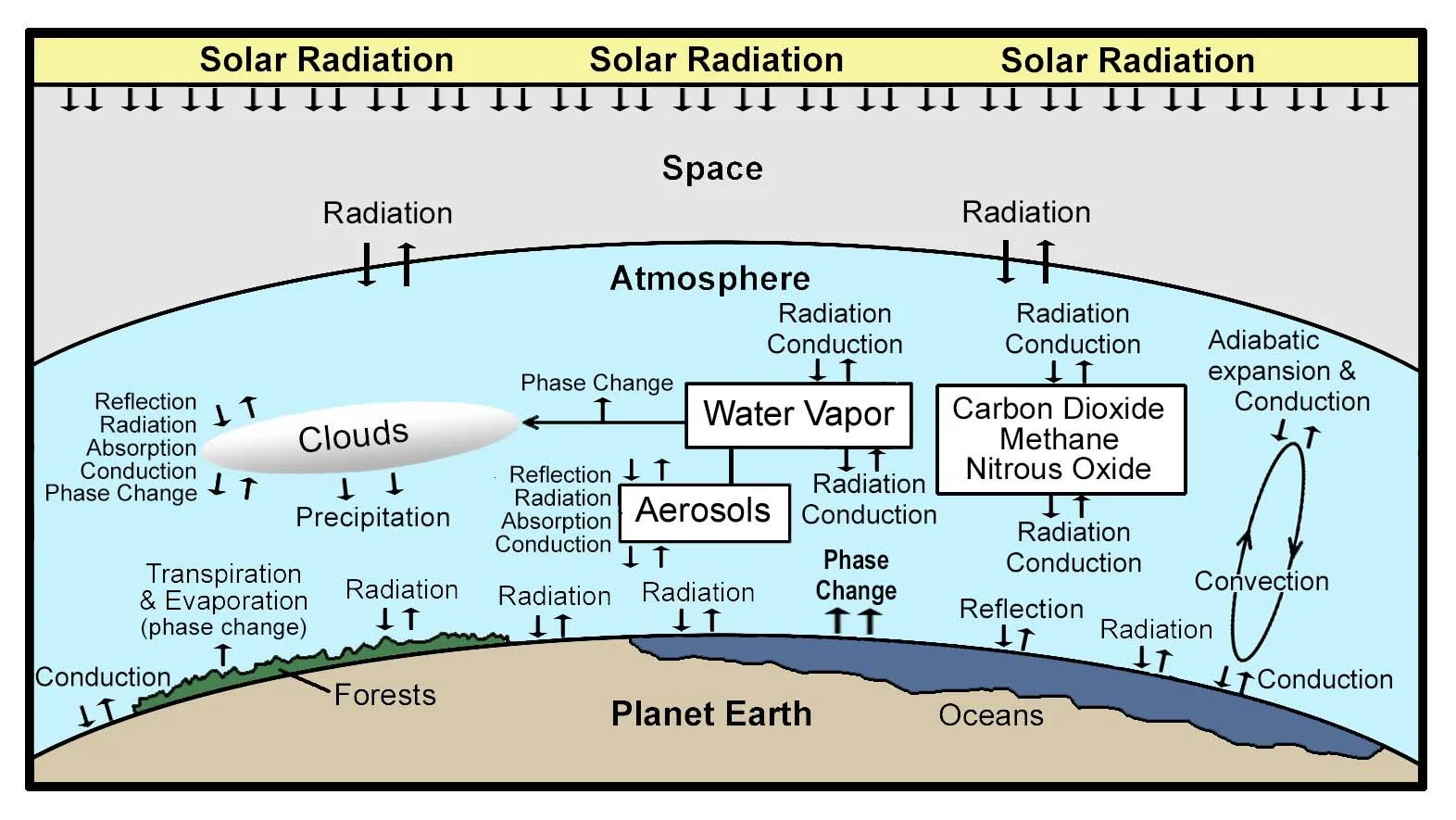
This needs to be looked at a little more closely – and it all comes down to heat/energy transfer. Let’s get down to basics...
Energy moves through the atmosphere in many different ways… It’s enough to make your head spin (and these are just the most obvious)
We need to figure out if one of these stands out as the primary driver of climate change.
2
How the atmosphere affects temperature…
Notes
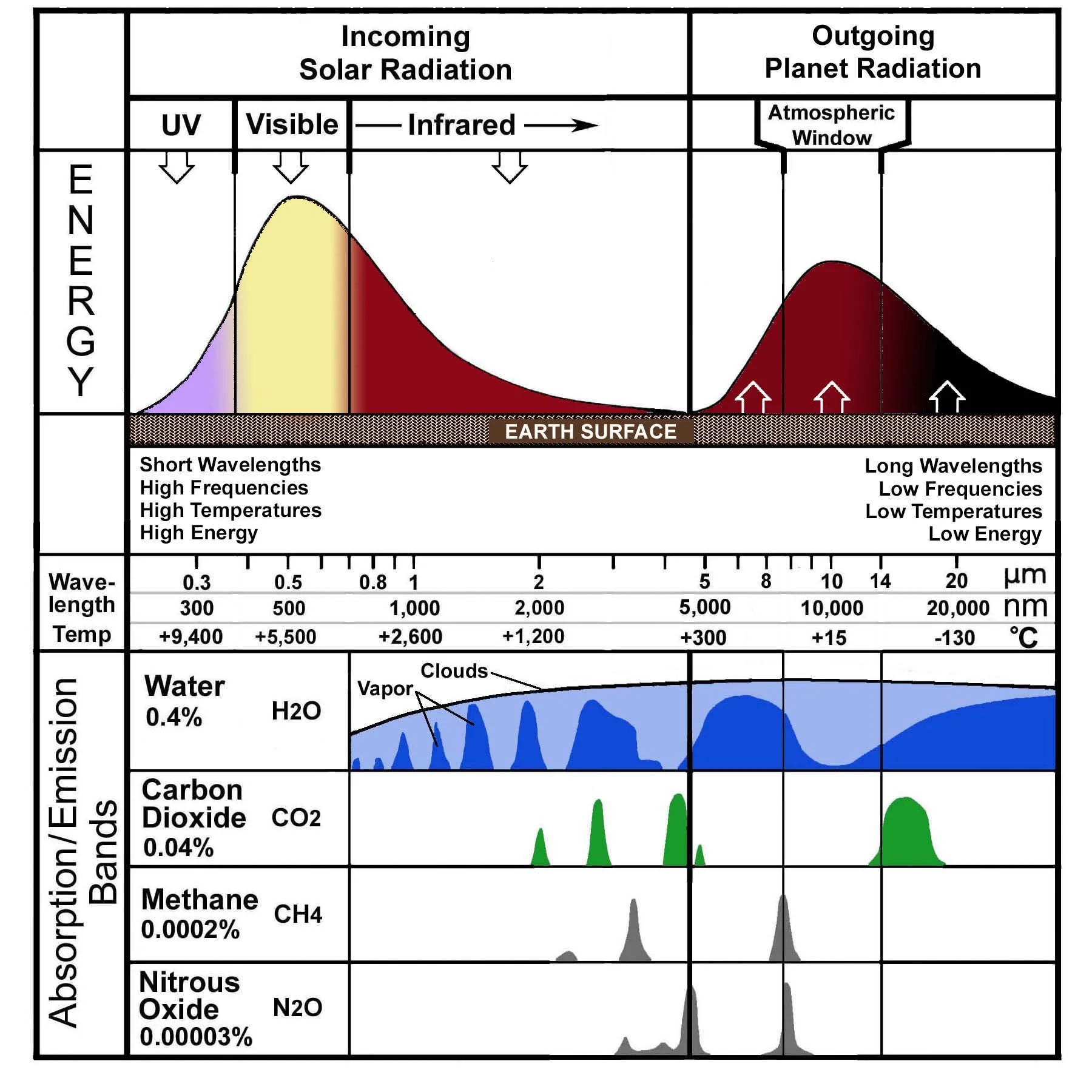
Energy (radiation/heat): The “mounds” illustrate the relative intensity of radiation energy at various wavelengths emitted by both the sun and the planet.
Wavelength: In micrometers/microns (μm) and nanometers (nm) - correspond to specific temperatures and frequencies (for simplicity, frequency scale is not shown). Shorter wavelengths = higher frequencies = hotter; longer wavelengths = lower frequencies = cooler.
Temp: Temperatures correspond to specific wavelengths.
Absorption/Emission Bands: The wavelength ranges within which certain molecules can absorb and emit radiant energy.
Water: The percentage of water shown is 0.4%; that’s an estimate of the total amount of water (in all its states) present in the atmosphere at any one time. Vapor is the gas state and invisible; clouds are accumulations of minute water droplets, ice pellets, or snowflakes (liquid and solid states).
General:
Most of the atmosphere is transparent to radiation, meaning energy waves just pass though unaffected. But within the atmosphere are a few gases that, because of their molecular makeup, can absorb energy and then emit a portion of that energy in all directions (some of it back in the direction it came from). So, although not quite technically accurate, they can be pictured as partial mirrors. These radiation-absorbing gases (commonly but incorrectly referred to as “greenhouse gases”) can have an impact on the flow of energy through the atmosphere.
RAGs can have either a cooling effect or a warming effect on the planet, depending on whether their absorption bands lie in the incoming solar radiation range or in the outgoing planet radiation range. A gas can only be described as a “greenhouse gas” if it has a net warming effect.
These gases absorb electromagnetic radiation within specific wavelengths and at various intensities – these are called “absorption bands” (shown as “mounds” in the diagram), and together they represent the “absorption spectrum” of a gas. The more prominent the bands, the more of them in its spectrum, and the higher the concentration of that gas in the atmosphere, the more effective it is at absorbing and emitting energy.
The diagram above shows the absorption spectrum of the four most significant of those gases and their relative quantity in the atmosphere: Water (0.4% - 4,000ppm), Carbon Dioxide (0.04% - 400ppm), Methane (0.0002% - 2ppm), and Nitrous Oxide (0.00003% - 0.3ppm).
Note that the total amount of water in the atmosphere varies considerably day to day and location to location, from near 0% up to 4% - 0.4% is the estimated global average. Water is present in the atmosphere in three states: gas (vapor, moisture), liquid, and solid (hail, snow). For simplicity, we can refer to all liquid and solid forms of water as “clouds” (accumulations of tiny droplets or snowflakes) since their absorption characteristics are very similar. In the illustration above, the dark blue “mounds” show the absorption spectrum of water vapor, and the combined dark and light blue area represents the absorption spectrum of clouds (see Wikipedia for more details).
Clouds absorb and emit radiation as does water vapor, but unlike gases, clouds also reflect energy; and since they are dense accumulations of tiny droplets, they also influence airflow within the atmosphere by physically “trapping” air beneath them, resulting in the formation of low-level convection cells. All this makes clouds unique and very effective at controlling the flow of energy to and from the planet. Aerosols (fine particulates) also absorb and reflect heat; but their effect is negligible compared to clouds unless they are present in huge volumes (such as during very intense volcanic activity); and they often have negative chemical or physical impacts on ecosystems.
Incoming (solar) energy:
Radiation energy, as streams of vibrating photons, is emitted by the sun and, in about 8 minutes, reaches the earth’s atmosphere. The frequency of those vibrating photons forms a wavelike pattern that can be translated into specific wavelengths, and those wavelengths relate to specific temperatures. The violet-yellow-red “mound” under “Incoming Radiation” represents the solar energy that reaches the outer edge of earth’s atmosphere (the sun’s radiation spectrum). The sun’s surface is about 5,500°C, so the peak of its emission spectrum is around 0.5μm.
Solar energy can be split into three main segments. The ultra-violet, made up of very high frequency photons (very short wavelengths); the visible portion with photons that vibrate at slightly lower frequencies (i.e. longer wavelengths); and then, the infrared portion at still lower frequencies and longer wavelengths. The ultra-violet and infrared are not visible to the naked eye.
The infrared carries about half of sunlight’s total “quantum” energy, but it’s more effective at warming the planet than visible and UV radiation (Herschel’s experiment). A good portion of the latter’s high frequency energy is “used up" altering the structure of molecules it interacts with rather than increasing their frequency, hence less warming.
Sunlight has to penetrate the atmosphere before reaching (and warming) the planet’s surface.
Looking at the spectrum of radiation-absorbing gases, it’s quite obvious that water vapor and clouds “intercept” a significant amount of radiation in the infrared segment of sunlight. True, there are a few small absorption bands of other gases that also lie in that range, but their effect is insignificant compared to that of water, especially considering that water is 10 to 13,000 times more abundant. Clouds add considerably to that cooling effect because their absorption spectrum cover the full infrared range of the solar radiation (and part of the visible), and, as we saw earlier, they also reflect energy. In other words, water in the atmosphere (in all its states) significantly reduces the amount of heat energy that reaches the planet’s surface.
Consequently, only about 70% of the solar energy that reaches the outer layers of the atmosphere makes it to the planet’s surface due to the presence of water vapor in the atmosphere (graph), and that is further reduced to about 50% when you factor in energy reflected by cloud formations. Then, 5 to 10% gets reflected at the surface (by rocks, soil, ice, water surfaces, buildings, etc.); the rest (40-45%) is absorbed by land and sea and warms up the planet.
Side note-1: There is also heat originating within the earth’s mantle - from compression, friction, radiation, radionuclides (radioactive materials), and leftover heat from the planet’s formation - and that heat continuously “migrates” to the surface and adds to the surface temperature; but it does so at such a slow rate that it contributes about 7,000 times less heat to the planet’s surface than the sun (and that process has been fairly steady for millions of years), so it has virtually no impact on climate fluctuations. Solar radiation is the primary source of energy for maintaining the planet within a suitable range of temperatures for most lifeforms, and this is what we’re focusing on.
Side note-2: One radiation-absorbing gas that has not been mentioned is ozone. It’s main function is to protect us from the sun’s damaging UV rays. As for its effect on heat transfer and the climate, it’s problematic - its effect on the stratosphere, the polar vortex, and the polar>tropics temperature gradient is not well understood, so more investigation is in order here - but it’s overall effect on climate is likely insignificant compared to H2O.
Outgoing (planet) energy:
If the energy the planet absorbs from the sun wasn’t “returned” back to space, the planet would gradually get hotter and hotter. So, to keep the temperature reasonably stable, the planet needs to release, or “radiate” about as much energy back into space as it absorbs from the sun. And since the planet absorbs energy over only half it’s surface at any one time, and radiates energy spherically and continuously, its emission intensity is about half as that absorbed by the planet (as reflected in the diagram by the relative areas of the incoming and outgoing energy “mounds”). The planet’s surface temperature is what determines the climate.
Heat is transmitted to the atmosphere at the surface by conduction-convection and through phase change, and then radiated into space*. So the atmosphere can be pictured as a giant heat sink, drawing heat from the surface and dissipating it into space. *Note that all gas molecules(not just RAGs) can absorb heat by conduction and then release that energy as thermal radiation.
The planet also continuously emits “black body radiation” (radiant heat) according to basic laws of thermodynamics: As long as their temperature is above “absolute zero” (-273°C), all “bodies” (solids and liquids) emit black body radiation (yes, even if that body isn’t black – only the darker the “body”, the more efficiently it radiates energy). Regardless of how that energy was “absorbed”, the emission spectrum of a black body is determined by that body’s surface temperature (Wien's Displacement Law).
The intensity of energy emitted by a black body (such as the earth) can be calculated according to Stefan-Boltzmann Law.
The energy the planet absorbs from the sun is re-emitted at frequencies/ wavelengths determined by the planet’s surface temperature, which is obviously much lower than the sun’s temperature, hence the energy is emitted at longer wavelengths (lower frequencies).
Now the average surface temperature of the planet is about 15°C – this means that the planet’s emission spectrum “peaks” at about 10μm, and ranges from about 5 to 50μm. In the diagram above, the energy emitted by the planet (its emission spectrum) is shown as dark red to black.
The radiation emitted by the planet needs to get through the atmosphere before “escaping” into space. And just as a portion of the sun’s energy is captured by radiation-absorbing gases on its way in, some of that radiation is “intercepted” on its way out and radiated in all directions by those gases, if their absorption bands line up with the planet’s emission spectrum.
As for gases, they all can radiate energy as well, but following different laws. Radiation-absorbing gases can absorb radiation within certain frequencies and re-emit that radiation at those same frequencies (Kirchhoff's Law of Spectral Analysis). Other gases are “transparent” to radiation, but they (and RAGs) can absorb energy by conduction and then emit radiation at various specific frequencies depending on their molecular makeup (graph).
As we can see from the diagram, a few of the radiation-absorbing gases’ bands do line up with the planet’s emission spectrum. A small one in the Nitrous Oxide spectrum at around 8μm, another in the Methane spectrum also around 8μm, and another (more significant) in the carbon dioxide spectrum around 15μm. But note that two water vapor absorption bands (dark blue) cover a very large portion of that spectrum, on either side of the peak – roughly from 5 to 8μm, and from 14μm and longer (The 5 to 8μm band being the most significant because it lies in the higher temperature/energy range). The combination of the CO2 and the dominant water vapor absorption bands absorb a good portion of the radiation emanating from the planet, leaving a fairly well defined “gap” in the middle, roughly from 8 to 14μm. That gap is commonly referred to as the “atmospheric window”; it happens to line up with the planet’s peak emissions and therefore allows most of the planet’s radiative energy to “escape” into space practically unimpeded – unless there is cloud cover.
When we look at clouds’ absorption band (light blue area combined with the dark blue mounds), the picture changes drastically. We can see that it covers the full range of the planet’s emission spectrum with no breaks. Furthermore, clouds also reflect energy back to the surface. So, as long as there are no clouds in the way, the atmospheric window is “wide open” and most of the planet’s radiative energy is free to escape, but when significant cloud formations are present, it effectively closes the window, and much of the heat is “trapped”.
Another factor to consider is that the planet is not at the same temperature all around - during ice ages (as we are now), the average temperature difference between the poles and the equator is in the order of 75°C - so the planet radiates heat much more strongly at the equator. On the other hand, ocean and air currents carry heat towards the poles, and at the poles the air is very dry so water vapor and clouds have very little effect, so that heat is dissipated into space rather easily.
RECAP
When we talk about “the climate”, we’re generally referring to a combination of temperatures, winds, rainfall, and snowfall over the long term (30 years or more).
Without the atmosphere to control and moderate the temperature, the planet would be unlivable. It would get hot enough in the daytime to boil water (over +100°C), and cold enough at night to freeze our butts (below -100°C).
Any discussion of global warming must examine the effect of the atmosphere not only on outgoing planet radiation, but also (and maybe more importantly) on incoming solar radiation. An extensive study posted on the PNAS website (Proceedings of the National Academy of Sciences of the United States) concludes: “We have shown that, in most models, the Outgoing Longwave Radiation reduction associated with Green House Gas forcing is alleviated within only a few decades and that the subsequent energy accumulation (and thus, global warming) is caused almost entirely by enhanced Absorbed Solar Radiation.” In other words: When it comes to the climate, it seems the effect of the atmosphere (and Radiation Absorbing Gases) on incoming solar radiation is of greater significance than its effect on outgoing planet radiation (the exact opposite of what most climate scientists claim).
In order to enjoy a reasonably stable climate, outgoing energy must roughly balance out incoming energy from decade to decade. So, something in the atmosphere needs to control either the amount of incoming energy, the amount of outgoing energy, or both; and it also has to be more or less “self-regulating”, even when solar energy fluctuates.
Although countless factors affect the climate, our quest is to try and pin down the dominant “climate control mechanism”, and determine if humans have somehow interfered with it.
________________________
3
So, what about Carbon Dioxide..?
Let’s take a closer look at carbon dioxide. Since rising CO2 levels has been determined by climate scientists to be “the main cause of climate change”, we want to check out if the big push to “decarbonize” is justified…
First, it may be fitting to point out that the human body is made up of about 65% Oxygen, 18% Carbon, 10% Hydrogen, and the remaining 7% are various other elements. In other words, we are about 83% Carbon and Oxygen (the two elements of CO2). That carbon comes mainly from plants that absorb carbon dioxide from the air - calling it “pollution”, or even “a poison”, when it’s the primary building block of nearly all life on earth is a bit far-fetched - like saying water is a pollutant. Yes, you can drown in water, but we still drink it. Now, how much is too much, and is it affecting our climate negatively... those are valid questions.
Are carbon dioxide levels too high..?
Plants need CO2 to grow, and greenhouse growers have figured out that the current CO2 level of ~420ppm is too low for optimum plant growth, so most commercial growers pump CO2 into their greenhouses and raise the level to somewhere between 600 and 1,500ppm (depending on the crop) - up to four times the current level in the atmosphere. So, as far as most plants are concerned, they’d be perfectly happy with more CO2. Incidentally, plants cannot live with CO2 level below 150ppm, and if plants die off, practically all land-based life on earth would die off as well - and we came dangerously close to that point 20,000 to 50,000 years ago (when CO2 levels dropped to about 200ppm). And as mentioned earlier, CO2 levels during the Jurassic period were 5 to 7 time higher than today. So if one is concerned about an “Extinction Level Event” related to CO2 levels, we have a lot more wiggle room on the upside than on the downside.
As for us humans, long exposure to CO2 levels above 1,500ppm can cause minor discomfort in some individuals. Maximum permissible level in the US workplace is 5.000ppm. Extended exposure to levels above 10,000ppm is considered unsafe for humans - other life forms are generally more tolerant.
So we can conclude that levels somewhere between 1,000 and 1,500ppm would be far better for plants and still perfectly fine for human/animal life.
Since early land plants and animals first appeared on our planet (about 800 million years ago), carbon dioxide levels have generally been much higher than they are now; for example, during the age of dinosaurs and plant and animal life flourished, not only was the temperature much higher than today, CO2 levels were 5 to 7 times higher than today!The only time over the past 600 million years CO2 levels were as low as they are today was during the Karoo Ice Age, about 300 million years ago!
So, CO2 levels evidently are nowhere near “critically high levels” for life on earth; in fact, we’re near critically low levels. And as we saw earlier, global temperatures are near record lows as well. Has the public been duped by the doomsayers..?
But what about carbon dioxide causing “global warming”…
Yes, that’s definitely the prevailing view - and it needs to be re-examined…
As we saw earlier, CO2 is a RAG (radiation-absorbing gas) and is deemed by climate activists to be the most important. As mentioned earlier, the idea that CO2 “traps” heat like a sheet of glass or a blanket over the atmosphere, and is the primary driver of “climate change”, is not new; it’s been kicked around for well over a century. But is it a valid hypothesis..?
The reasoning generally goes something like this:
Sunlight reaches the planet’s surface and warms it up.
The planet radiates most of that heat back into the atmosphere at longer wavelengths.
CO2, because of its particular molecular structure, “captures” some of that heat before it can “escape” into space and radiates it back towards the earth; so the heat is sort of “trapped” (just like in a greenhouse) and the planet gets warmer.
Burning fossil fuels adds CO2 to the atmosphere.
The more CO2 in the atmosphere, the greater the warming effect – and we have been burning a lot of fossil fuels (coal, oil, natural gas, propane, etc) over the past few hundred years.
If that warming gets out of control, we will face excessively high temperatures, and some say this will lead to more extreme “weather events”, more floods, more forest fires, the icecaps will melt, ocean levels will rise, and eventually it could destroy most of life on earth.
Scary stuff..! But does it stand up to scrutiny…
Note that the effect radiation-absorbing gases might have on incoming solar energy is usually ignored, seldom mentioned, or summarily dismissed.
As I said, it does seem to make sense – especially since carbon dioxide levels and temperature do seem to rise and fall together (barring other significant geological or cosmic events, and providing you don’t go back too far in time). As for floods, forest fires, and extreme “weather events”, there’s no clear evidence that those are on the increase globally - and contrary to the general consensus, “extreme weather events” are not likely to increase as the planet warms up - on the contrary, as the poles warm up and the ice melts away, the reduced temperature gradient between them and the equator will likely result in a “calmer” climate.
To top it off, a long list of seemingly well informed and respected organizations and scientists support these views. A quote from the United Nation’s website: “Burning fossil fuels generates greenhouse gas emissions that act like a blanket wrapped around the Earth, trapping the sun’s heat and raising temperatures.”
True, there are disagreements on how much CO2 causes how much warming; or if more energy is absorbed on the “shoulders” of the absorption bands than at the peaks; or how much is emitted by nature and how much by man; or how much is absorbed by plants and oceans; or how long we have before the climate “apocalypse”, etc. etc… however, they all link CO2 levels directly to temperature, and seem to ignore everything else. But if the premise is not supported by verifiable observations, all this is like arguing about how many angels can dance on the head of a pin.
We need to go back to basics and examine the premise. We need to look a little closer at the facts…
Can carbon dioxide actually “trap” heat emitted by the planet..?
Years ago, when I began to look into this and checked out the absorption spectrum of CO2 in relation to the emission spectra of the sun and the planet, it struck me that things didn’t seem to “line up” as expected. So I did more digging and more ruminating - still it kept leading me back to the same “off-the-beaten-track” conclusions. Let me explain…
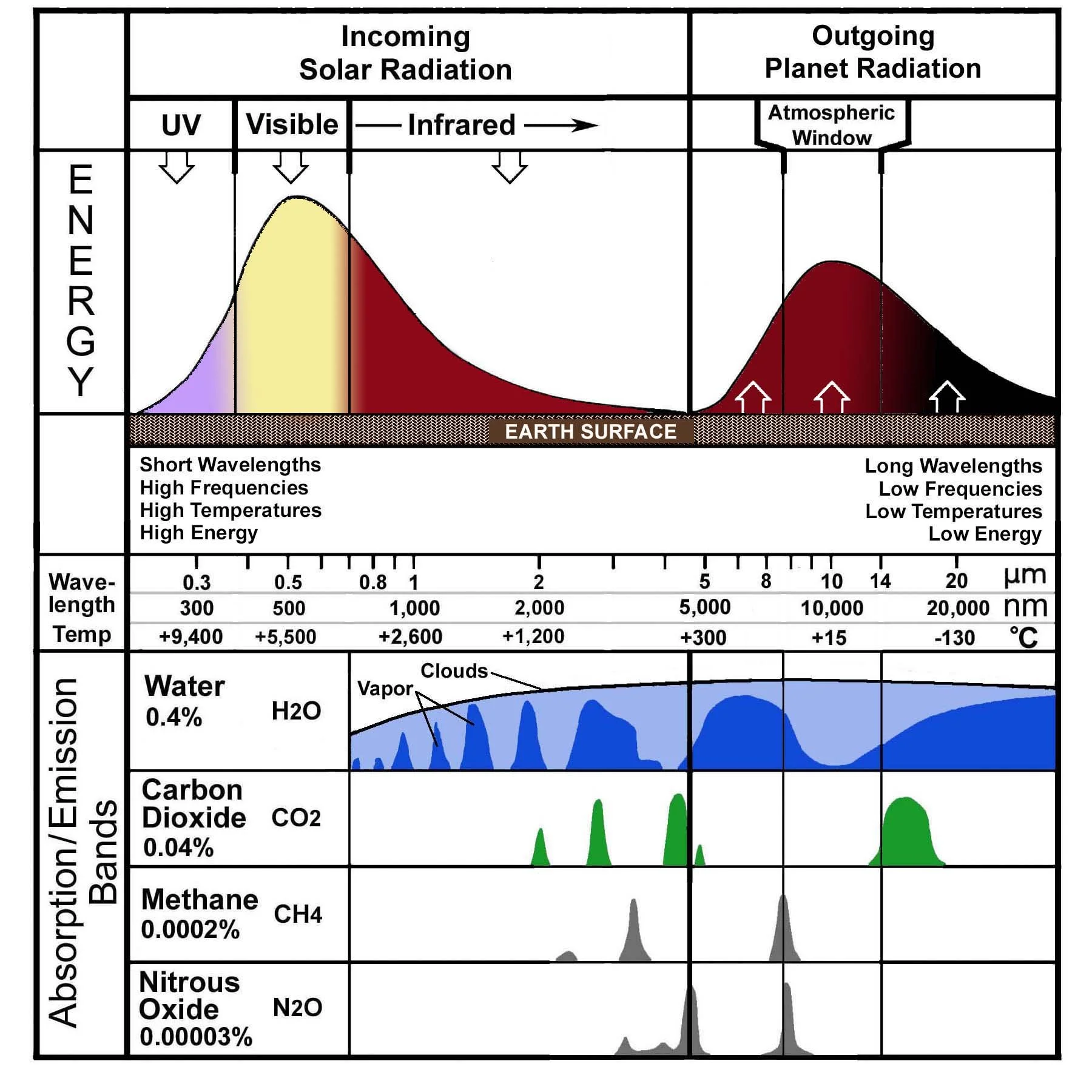
As we saw earlier, radiation-absorbing gases “capture” energy within specific frequency bands (ranges), dissipate some of that energy to surrounding gases, and return a portion of it back towards its source. The only band within the carbon dioxide spectrum that overlaps significantly with the planet’s emission spectrum peaks around 16μm - just to the right of the atmospheric window (see the graph above). This is at very low energy levels, and corresponds to temperatures in the range of -60 to -100°C (that’s at the level radiated in the polar regions) - considerably colder than the average surface temperature of the planet (about 15°C). So any of that long wave energy that’s returned to the planet’s surface by CO2 molecules barely has any effect on the planet’s overall temperature.
It bears mentioning here that satellite readings of the earth’s emission spectrum do show a significant dip in the planet’s radiative emissions in the 14-18μm range, and this is taken as “proof” that CO2 “traps” heat and warms up the planet. Like they say, “The devil’s in the details”.
A couple of other bands in CO2’s spectrum (at around 2 and 2.7μm) lie near the tail end of the sun’s spectrum (in the infrared) - those “return” a portion of the sun’s heat energy back to space, and have a slight cooling effect. That section of the sun’s spectrum doesn’t carry that much energy, but it still amounts to considerably more than the planet’s radiative output in the 16μm range (where the previously mentioned band lies).
Lastly, one band sits right on the “border” between the sun’s spectrum and that of the planet (at around 4.3μm) and likely has barely any effect either way.
Now, for a gas to be classified as a “greenhouse gas” or “planet-warming gas”, its absorption spectrum needs to lie within the earth’s emission spectrum.
For a gas to be classified as a “planet-cooling gas”, its absorption bands need to lie within the sun’s emission spectrum at wavelengths shorter than 4.5μm.
If the absorption bands of a gas lie within both warming and cooling ranges, their relative number, magnitudes, and positions in relation to incoming and outgoing energy determine if that gas is net-warming or net-cooling. Carbon dioxide is in this category. More work needs to be done on this, but I contend that the net effect of carbon dioxide on the planet’s temperature is negligible either way.
Another factor to take into account is that CO2 reaches near-saturation level at around 400ppm - i.e. further increases in concentration make very little difference to its effect on temperature (Happer & Wijngaarden). For example, doubling the CO2 level from the current 400ppm to 800ppm would increase its absorption potential by 1%.
Note that CO2 molecules can also combine with water molecules and form carbonic acid (necessary for photosynthesis), this is an exothermic reaction that does contribute to warming up the atmosphere (not so much the planet).
So, unless CO2 is some magical substance that defies the laws of physics and thermodynamics, it cannot possibly be classified as a potent “greenhouse” or planet-warming gas, and cannot be the primary driver of climate changes. That theory needs to be put to rest once and for all.
Maybe I’m missing something here; but if I am correct, then many scientists have failed to see the obvious… And from looking at proposed lab experiments to supposedly “demonstrate” the greenhouse (warming) effect of CO2, I tend to believe the latter. Most of those experiments call for heat sources (such as heat lamps) that are in the 1,000 to 3,000°C range, well above 300°C (therefore in the sun’s visible and infrared range, nowhere near the planet’s black body radiation range - example); a few even suggest using sunlight as a heat source. This is laughable! Those experiments only demonstrate that CO2 has planet-cooling potential! And as if that’s not bad enough, many introduce water vapor into the mix, making the results totally meaningless.
And note that these experiments show how much energy is transmitted to the gases within the containers, and not how much energy is re-emitted back out.
To better illustrate the IR absorption effect of CO2 relative to non RAGs, may I propose this alternative(for those who are interested).
Now, as for the other radiation-absorbing gases, one of methane’s bands does line up with the planet’s emissions, but another is in the sun’s infrared range (at lower intensity but higher energy level); so its net effect is likely to be close to neutral (the fact that it’s more “effective” at absorbing infrared than CO2 then becomes practically irrelevant), especially since its concentration in the atmosphere is about 200 times less than CO2, and 2,000 times less than H2O - so I think we can put that one back on the shelf. Farmers can continue to grow rice and let their cows burp to their heart’s content.
Nitrous Oxide’s concentration is infinitesimal (1,300 times less than CO2, and 13,000 times less than H2O) and its absorption bands very narrow - a small blip on the radar. Even the most acrobatic of computations and far-fetched theories cannot alter those facts; so, regardless of its molecular makeup, it can also be dismissed as a major contributor to global warming.
I believe both Methane and Nitrous Oxide barely deserve any mention when it comes to “climate change” (unless one is desperate for more reasons to expand bans and controls).
Now, what about the fact that temperature and CO2 levels seem to move synchronously..? Generally yes - all else being equal, and in the short term, they do tend to move more or less in tandem. But is it one causing the other? (and if so, which is causing which) or is it something else causing both to change..?
CO2 is highly soluble in water, and its solubility increases as temperature decreases and decreases as the temperature increases (inverse relationship). So it stands to reason that as temperatures drop and oceans get colder, they absorb large volumes of CO2 (and significant amounts also get trapped in ice sheets); and as the ocean temperature rises again (and the ice melts), much of that trapped CO2 is released - just like CO2 bubbles out of soda pop as it warms up (referred to as “degassing”). Historical ice core evidence indicate that temperature increases have generally preceded atmospheric CO2 level increases by about 800 years, suggesting that increases in CO2 levels are a consequence of temperature changes - not the other way around. “The sequence of events during Termination III suggests that the CO2 increase lagged Antarctic deglacial warming by 800 +/-200 years”. So we have to conclude that something other than CO2 causes a rise in ocean temperatures, which in turn causes CO2 to degas. Over the long run though, that synchronism between CO2 and temperature is not always consistent due to numerous other factors that affect the CO2 cycle, including chemical rock weathering.
Methane and nitrous oxide display similar solubility properties to CO2, so their levels in the atmosphere will generally correlate with those of CO2.
________________________
Putting things into perspective
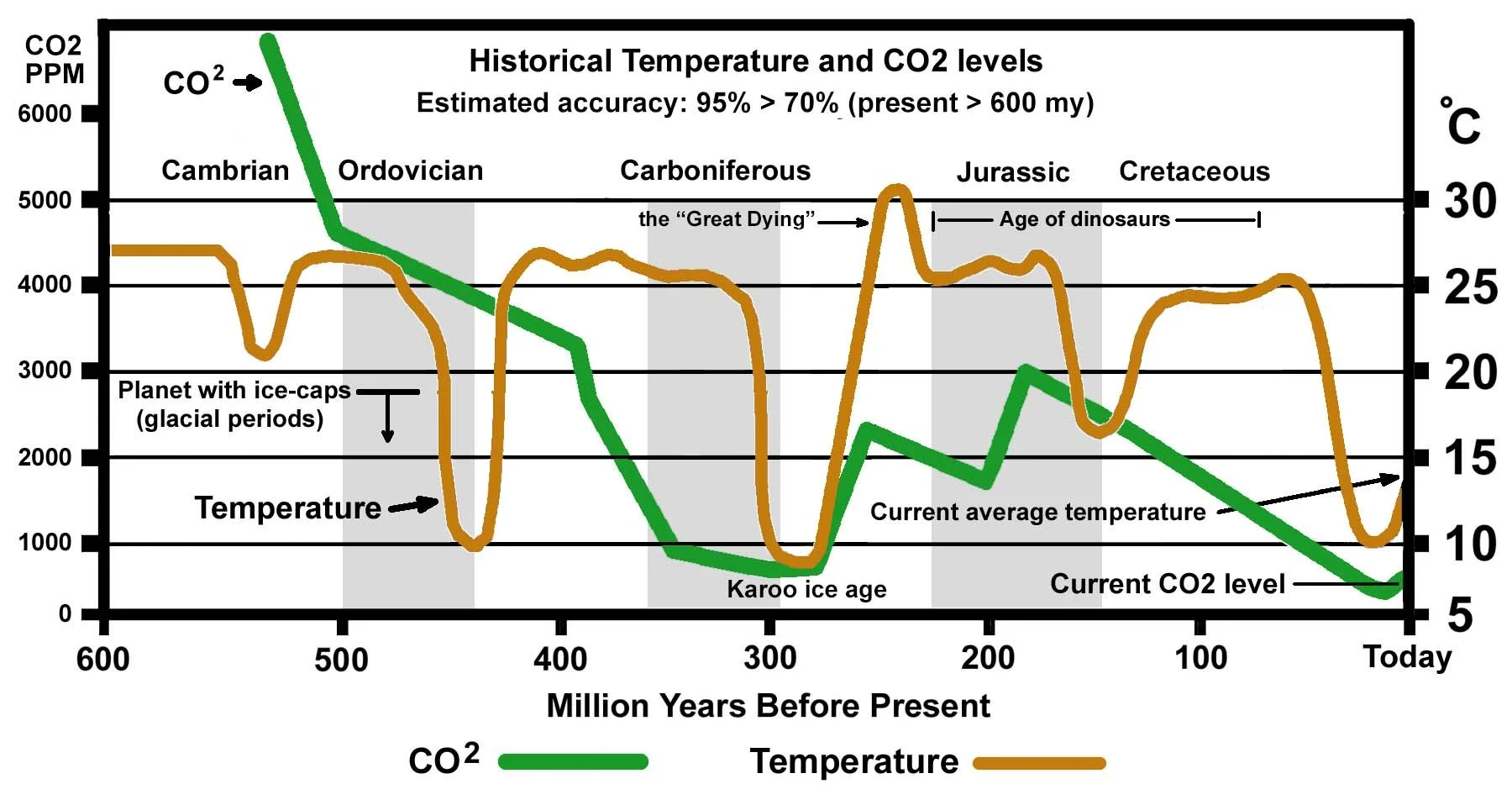
There has been no direct and consistent correlation between temperature and CO2 levels over the last 600 million years...
Current CO2 levels of about 400ppm are nowhere near “all time high”, or “dangerously high” as we’re constantly told - in fact, they’re near all time lows.
Over the past 600 million years, the only time CO2 levels were as low as they are now was during the Karoo ice age, about 300 million years ago..!
Note that most climate alarmists conveniently avoid going back further than 15 million years or so (that’s back to the deepest portion of the current ice age); an extremely narrow time slot, geologically speaking - definitely not “all time” - but it does make their numbers (and graphs) look good. Multicellular plant and animal life appeared around 600 million years ago - this is the time period we need to focus on (note that the planet is about 4.5 billion years old).
Now, so far, we’ve been primarily focusing on radiative energy transfer, but as we’ve seen earlier, there are other thermodynamic ways heat moves within the atmosphere: conduction, thermalization, convection, phase changes, adiabatic heating and cooling, etc. So let’s look at how RAGs fit into all this.
Something significant is usually ignored: Not all RAG molecules that absorb long wave radiation (photons) coming from the planet actually re-emit photons - this is because those molecules don’t re-emit photons immediately when they are energized, it takes some time before they do (referred to as their “radiative lifetime”). And these molecules are not sitting alone in a vacuum, they bathe in a sea of other fast moving molecules (mostly N2 and O2) that are constantly bumping into each other. When an “energized” RAG molecule bumps into some other molecule, its vibrational energy is transformed into kinetic energy (thermalization), and it does NOT emit a photon. Now those collisions occur at a rate of about 50,000 per second in the lower atmosphere; on the other hand, the radiative lifetime of CO2 and H2O molecules is in the order of 1 second at 16μm; so chances are most of those molecules would “de-energize” by collision long before they can re-emit a photon; and of those few that do, their emitted photon would likely be “intercepted” within a short distance by some other CO2 or H2O molecule, and the process would repeat itself… So, in effect, most photons just “bounce around” within the atmosphere for a short time until they are thermalized*. That energy is carried into the upper atmosphere and finally gets radiated into space (where molecules are farther apart and radiation can freely “escape”). So in the end, most of the energy radiated by the planet ends up warming the atmosphere, and never makes it back to the planet (thermal heat within fluids goes up, not down). Note that when a RAG molecule in its ground state bumps into some other molecule, it gets energized (dethermalization), but it too is likely to quickly get “rethermalized” in the next collision, so the net effect on temperature in minimal.
* This “entrapment” of photons within the troposphere (lower atmosphere) could also explain why CO2 reaches a “saturation level” where additional CO2 makes very little difference.
Views from a few prominent scientists:
Physics Nobel laureate Dr. John Clauser has spoken out against the climate change agenda, calling it "a dangerous corruption of science that threatens the global economy and the well-being of billions of people." William Happer and Richard Lindzen, both well-known and respected climate scientists, wrote that the damage from carbon dioxide emissions has been exaggerated by “an unscientific method of analysis based on consensus, peer review, government opinion, models that don't work, and cherry-picking.”
Richard Lindzen, Professor Emeritus of MIT, recently spoke in Brussels, at the invitation of the Hungarian political think tank MCC; here’s what he said in conclusion: "So here we are, confronted with policies that destroy western economies, impoverish the working middle class, condemn billions of the world’s poorest to continued poverty and increased starvation, leave our children despairing over the alleged absence of a future, and will enrich the enemies of the West who are enjoying the spectacle of our suicide march, a march that the energy sector cowardly accepts, being too lazy to exert the modest effort needed to check what is being claimed. Hopefully, we will awaken from this nightmare before it is too late.”
I would sum it up this way:
“The whole anti-carbon, anti-fossil-fuel movement may turn out to be the worst and most expensive boondoggle in modern history.”
Wikipedia - Boondoggle, def.: “A boondoggle is a project that is considered a waste of both time and money, yet is often continued due to extraneous policy or political motivations.”
Change won’t come easy - let’s not forget the all-powerful, successful, well-established, anti-CO2, anti-fossil-fuel, anti-capitalism movement. No one wants to admit they were wrong or led astray; no one wants to lose face, least of all respectable organizations, educators, journalists and politicians…
Tolstoy: “I know that most men, including those at ease with problems of the greatest complexity, can seldom accept even the simplest and most obvious truth, if it would oblige them to admit the falsity of conclusions which they have delighted in explaining to colleagues, which they have proudly taught to others, and which they have woven, thread by thread, into their lives...”
The mind also has a tendency to “select” evidence that seems to confirm one’s beliefs, and block out anything that contradicts them. A good scientist needs to be willing to consider alternatives, even when it feel… “uncomfortable”. Let’s hope truth, reason, and common sense will prevail at some point….
And of course, there will always be those individuals, companies and organizations whose snouts are buried so deep in the trough that they will keep on gorging until the manna runs out.
So, assuming I’m correct in my analysis, we can dismiss carbon dioxide, methane, and nitrous oxide as significant contributors to climate change. We need to keep digging…
________________________
4
If it’s not Carbon Dioxide, what else could it be..?
Could it be direct heat sources..?
This is somewhat elementary, but it’s worth mentioning. Combustion, friction, electric currents, air conditioners, car engines, heaters, refrigerators, power plants, etc. etc. all add energy directly to the climate system and contribute to “warming”. Individually, any one of those may not seem like much, but do they add up to a worrisome amount..?
Over the past couple of hundreds of years, industrial activities and the burning of fossil fuels have resulted in a significant increase in heat outputs (I’m leaving out forest fires because there have always been forest fires). How significant is it? It’s difficult to quantify, but it’s estimated that humanity currently consumes something in the order of 15 to 20 TWh (terawatt/hour) of energy from various sources - that’s about 10,000 times less than the total amount of solar energy continuously reaching the earth’s surface (~170,000 TWh). To put it another way, solar energy reaching the planet in one hour is equivalent to the total heat output of all of humanity for one year. So compared to the sun, our direct heat contribution to the system is negligible; definitely not enough to affect the planet’s overall temperature significantly (except locally, where heat outputs are concentrated, such as in large cities and industrial centers). .
And that leads us to the role of water in the atmosphere…
It’s estimated that H2O (in all its states) makes up about 0.4% of the atmosphere, that’s about 10 times more than CO2, 2,000 times more than Methane, and 13,000 times more than Nitrous Oxide. Not only that, the absorption spectrum of H2O is considerably more significant than that of CO2. Now most “climate scientists” do agree that H2O is “the most potent greenhouse gas”, but it is summarily dismissed as a driver of climate change. I believe it’s a serious mistake, especially when you consider the combined effects of moisture and clouds…
The argument generally goes something like this:
“CO2, and to a lesser extent CH4 and N2O, trap heat and “cause” the temperature to rise; this results in greater evaporation and increased moisture in the atmosphere.” (The first part of that statement, as we have determined earlier, is highly questionable - like claiming the tail is wagging the dog.) “That extra moisture traps more heat, sets up a positive feedback loop, and “amplifies” the warming effect of CO2, CH4 and N2O by a factor of two or even three.” (Only true if the first statement is true; and, as we’ll see later, the fact that moisture does create feedback loops is actually the key to understanding its dominant role in controlling the climate. And note that IF CO2 were a significant planet-warming gas, an increase in CO2 concentration would warm up the planet and cause more CO2 to be released from the oceans - also a feedback loop.)
“The amount of water vapor present in the atmosphere is in direct relation to the temperature.” (Generally true)
“The amount of water in the atmosphere varies greatly from day to day, or even hour to hour, so it could not be responsible for long-term climate change.” (Locally, true, and it does affect the weather; but the total amount of moisture in the atmosphere globally is what matters, and that varies very little from year to year)
“The water cycle is a ‘naturally occurring phenomenon’ and not directly affected by human activities (i.e. can’t pin it on “Big Oil” - their favorite boogeyman), so it could not possibly be the driver of modern day anthropogenic climate change.” (We will see later how man’s activities can affect the water cycle significantly.)
“Water doesn’t accumulate in the atmosphere; it is short-lived compared to carbon dioxide which stays in the atmosphere for years, or even centuries.” (True, individual water molecules typically don’t remain in the atmosphere as long as CO2 molecules, but that’s completely irrelevant if they’re continuously being replenished; and depending on various factors, both moisture and CO2 concentrations in the atmosphere do vary over time - CO2 simply has a somewhat longer cycle. And the very fact that the water cycle is relatively short offers some hope that if the problem is associated with moisture, and if we are responsible for disturbing the balance, then it should be easier to correct. And the water cycle is not as “complicated” as the CO2 cycle, so it may also be easier for us to improve our computer models)
Again, there is usually little mention of the role clouds, moisture, and CO2 have on incoming solar energy - they seem to assume that all radiation-absorbing gases are planet-warming gases.
Renowned hydrologist Dr. Demetris Koutsoyiannis of the National Technical University of Athens, and 2014 recipient of the prestigious Dooge medal (awarded by UNESCO and the World Meteorological Organization), in a thorough and very well-researched 2021 technical paper, Rethinking Climate, Climate Change, and Their Relationship with Water, concludes that “Water is the main element that drives climate, rather than just being ‘affected’ by climate as commonly thought”.
Obviously, the role water plays in determining the climate needs to be more closely examined…
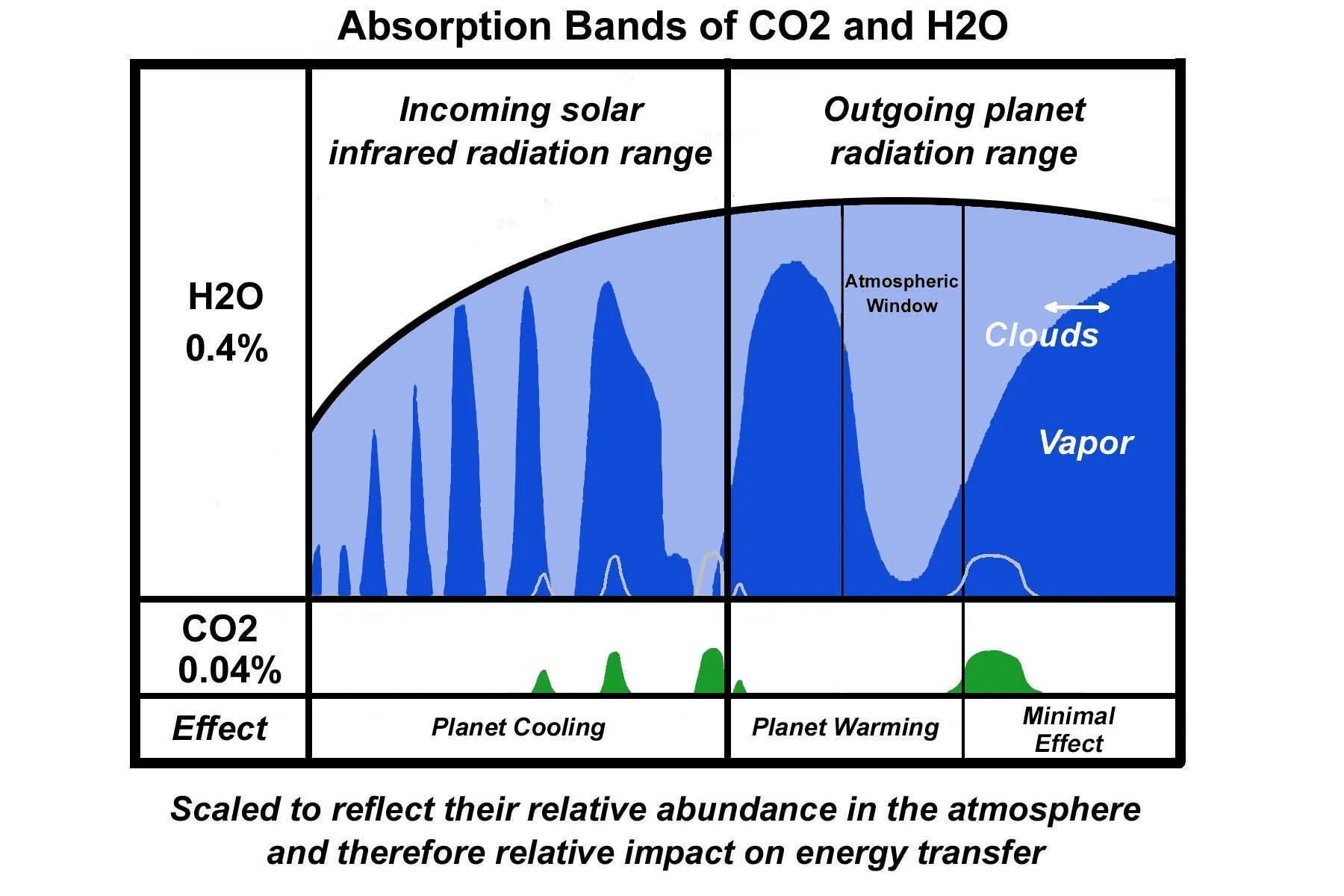
(CO2 compared to H2O penciled in white)
Water vapor’s absorption spectrum dramatically overshadows that of CO2, especially when you consider their relative abundance in the atmosphere (as illustrated above), so its effect on the climate is immeasurably more significant. And when you factor in the effect of clouds, CO2’s role is insignificant. If Methane and Nitrous Oxide were scaled in as well, their absorption bands would be smaller than the dot at the end of this sentence - so regardless of their molecular makeup, their effect on the climate doesn’t even deserve a mention (contrary to the claims of most climate scientists; you can only stretch things so far).
To recap, water is found in the atmosphere in all of its three states: as a gas (water vapor), as a liquid (fog, clouds, and rain), and as a solid (snow, clouds and hail). And let’s not forget that most of the solar energy that reaches the planet’s surface is stored in the oceans, and determines the climate. Water is an amazing substance - it’s the Swiss Army Knife in the planet’s climate toolbox.
It all begins with the oceans:
Oceans absorb a large portion of the solar energy.
They have a huge thermal storage capacity.
They radiate some of that energy into space.
Through evaporation (phase change), they transmit huge amounts of energy to the atmosphere - accounting for up to 75% of the energy transferred from the planet to the atmosphere.
They help moderate the temperature and control the climate (thermal stability).
They “transport” heat to cooler parts of the world (ocean currents). Note that ocean and air currents can have a major effect on local climates.
They provide huge surface areas for evaporation and cloud formation; air currents then “transport” that moisture to land masses where it’s essential for life.
Water vapor:
Water vapor (humidity) is invisible and is the most potent of all radiation-absorbing gases. And since its absorption bands lie in both the solar spectrum and the planet spectrum, it acts as both a cooling gas and a warming gas. But, as we’ve seen earlier, its net effect is generally thought to be a warming effect because it apparently captures a somewhat larger percentage of the planet’s radiant energy than of the sun’s incoming energy (although more work needs to be done on that as well).
Clouds:
Clouds are, say… “special”
The process of cloud formation acts as a gigantic phase-change “heat pump” – As water evaporates (and ice sublimates) from the planet’s surface (including vegetation), it “draws” a considerable amount of heat from it (phase change) - accounting for up to 75% of the total energy transfer from the planet’s surface, dwarfing other processes like conduction, convection, and radiation; when that moisture condenses and forms clouds, it releases that heat into the atmosphere (again, phase change). That energy triggers convection currents that carry the warmer air higher up and encourage more evaporation; this turbulence and adiabatic expansion “use up” a considerable amount of energy, and the rest is released into space as molecular radiation. This process and, to a lesser degree, long wave radiation from the planet’s surface, are the two most significant ways heat is “removed” from the planet’s surface and transferred to the atmosphere. That energy is then radiated into space from the upper layers of the atmosphere - very little energy is radiated directly from the planet into space.
They “trap” heat – Since they’re dense accumulations of tiny droplets or flakes, they physically trap warmer air below them, and cause the formation of low-level convection cells. They also “capture” a good portion of the planet’s black body radiation and transfer it to the atmosphere.
And as we’ve seen earlier, clouds also reflect solar radiation back into space - they have a high albedo; dense clouds can reflect up to 90% of solar radiation (not just in the infrared, but in the visible range as well). So they prevent a good portion of the sun’s heat from reaching the planet’s surface.
Another consideration is that moisture and clouds are concentrated in the lower atmosphere (the troposphere), which contains about 80% of the total mass of the atmosphere, so their effect on ground-level air temperature is of even greater significance than that of other RAGs that are spread out to much higher levels. The upper portion of the atmosphere essentially radiates energy back into space.
So clouds are the ultimate regulators - they both reflect heat back into space, and trap heat within the lower atmosphere. The question is: What is their net effect..?
Yes, obviously many other factors affect the climate, but it seems quite clear that, in the long run, none are as significant and as consistent as the role moisture and clouds play.
And most climatologists do agree that humidity and cloud cover affect the planet’s temperature; but that it is the dominant factor when it comes to controlling the planet’s long-term temperature and the climate is not widely accepted because, you know, 97% of scientists...
As mentioned earlier, there’s no consistent link between CO2 levels and temperature in the geological past, but it seems there is a strong long-term correlation between the level of moisture in the atmosphere and the average global temperature. Yes, it’s a feedback loop but,because of cloud formations, it’s a self-regulating feedback loop. Let’s dig into this a little deeper...
Moisture and the climate
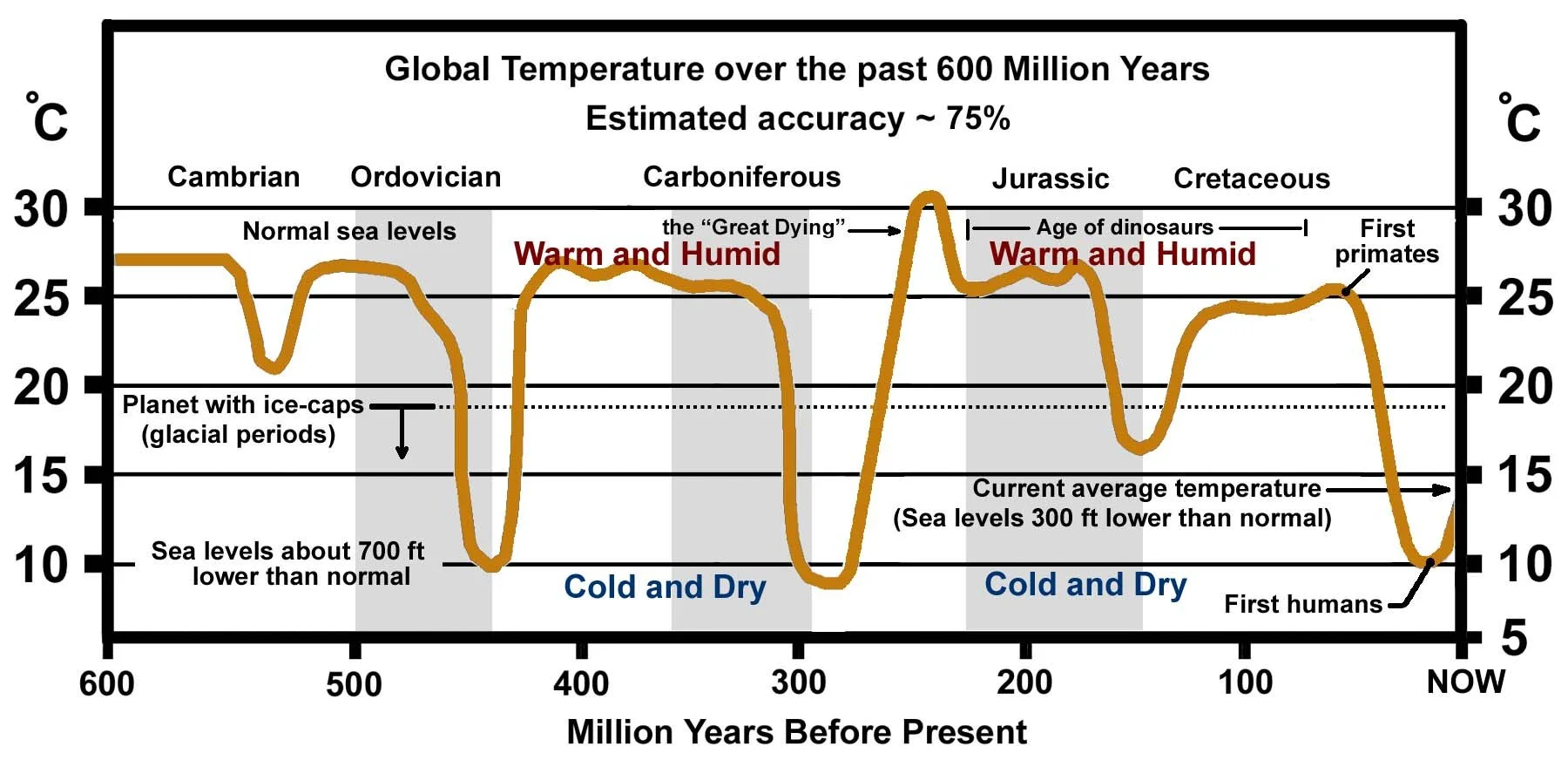
Let’s go back to our graph of the planet’s historical temperature - btw, you will find a few that look like this on the net - this is my own version, a compilation of the more reliable ones and my own research. Although not all identical, most tell a similar story. Note that these graphs don’t show the short-term fluctuations.
As we’ve seen earlier, over the past 600 million years, global temperature has fluctuated between 10 and 30°C, and most of the time, it hovered around 25°C IN SPITE OF NON-SYNCHRONOUS VARIATIONS in CO2, CH4 and N2O levels, solar radiance, continental drift, volcanic activity, and numerous other factors. So there has to be some built-in mechanism (other than those) that tends to maintain the temperature around 25°C. True, occasionally (every 150 million years or so), something triggers a serious drop in temperature and leads to an ice age, but it doesn’t take too long (geologically speaking) for the “heater” to kick in and bring it back up to “normal”.
Barring divine intervention, it must be something going on within the atmosphere, and the WATER cycle (especially cloud formation) is the only mechanism that seems capable of “doing the job”with any degree of consistency– no way can it be carbon dioxide!
Now, we don’t have a very accurate record of moisture levels in the distant past, but we do know that during ice ages, the air is quite dry and there’s a significant temperature gradient between the poles and the equator (about 75°C). During the “normal” warm periods, it’s generally very wet and humid, and the temperature gradient is quite narrow (5 to 10°C). These are important clues.
So, allow me to speculate a little here… At the deepest part of an ice age, humidity and temperatures are low and there is limited cloud cover (especially over land in lower latitudes) so a fair amount of solar radiation reaches the planet - but ice sheets and snow in the mid and higher latitudes still reflect a good portion of that radiation back to space so the system is in some kind of precarious balance - and that seems to be at around 10°C. Then at some point, the warming effect of the sun begins to “win over”: the ice sheets gradually retreat, the exposed land and sea absorb more heat, and the planet warms up. As more water evaporates and more humidity enters the atmosphere, the cloud cover gradually builds up; but because there is still a significant heat gradient between the poles and the equator, strong air currents quickly carry those clouds towards the higher latitudes so there’s still a strong warming effect along the equator and lower latitudes and evaporation is still significant - clouds also “trap” more and more heat and moisture near the surface, further contributing to the warming effect. Gradually, as the northern latitudes warm up and the ice melts, the equator-poles temperature gradient narrows, air and ocean currents slow down, and cloud cover builds up along the equator and the lower latitudes; at some point, the cooling effect of clouds balances out with their warming effect, and the system reaches its most stable equilibrium (where solar energy absorbed by the planet equals the energy it releases into space); and that seems to be at around 25°C surface air temperature.
If the temperature exceeds that limit, it leads to more evaporation and an increase in cloud cover (higher albedo), and lowers the temperature back down. If the temperature drops below the balance point, it results in a reduction in cloud cover (lower albedo) causing the temperature to rise. This could be the “thermostat” we’ve been looking for.
As a side note, worldwide cloud cover is currently around 65% (most of that over oceans).
Dr. Clauser seems to have reached the same conclusion (coming from a top physicist’s perspective). Here’s a quote from his recent interview on EPOCH TV: “…it is this fluctuation in the cloud cover of the earth that causes a sunlight reflectivity thermostat that controls the climate, controls the temperature of the earth, and stabilizes it very powerfully and very dramatically”.
As for RAGs (especially water vapor), they essentially help “dampen” or slow down the flow of energy to and from the planet, keeping the lower atmosphere within more comfortable temperature limits through night/day cycles - they return very little radiation to the planet itself, so they do little to significantly affect the long-term average temperature.
To illustrate, consider the moon; its surface temperature goes from a daytime high of about 105°C down to -180°C at night (without an atmosphere, there’s no above-ground “damper”), but below ground (in deep pits for example) the temperature of the rock maintains a fairly even and comfortable 17°C (NASA). For lack of an atmosphere, the top layers of dust and rock on the moon act as a damper. If the surface was darker (lower albedo), the sub-surface temperature would stabilize at a greater depth and at a higher temperature; if the surface was lighter (higher albedo), it would stabilize at a shallower depth and a cooler temperature. At the extreme, if the moon’s surface was a theoretical perfect mirror (albedo of 100%), all of the sun’s radiation would be reflected, and the surface would remain extremely cold day and night.
At the other end of the spectrum, we have Venus, with an extra thick and dense (mostly) CO2 atmosphere. It’s often cited as a perfect example of “extreme CO2 forcing” and “runaway greenhouse warming”. I disagree. For those who are interested, here’s my take on Venus.
So, it’s my contention that, barring internal heat-generating processes, the temperature of any substantial celestial body at the same distance from the sun, rotating at the same speed, and with similar albedo, would tend to stabilize at similar “target” temperatures, just below the damper zone. For a rotating body, the depth of that “zone” is determined by how far down heat can migrate during the energy input stage - the slower the rotation, the deeper the target point; that heat is then conducted back to the surface during the “night”, and radiated into space. After some time, the input and output reach a balance, regardless of the type of materials the energy penetrates (and regardless of the varying heat interactions between those materials). Say you select a spot a little above the bottom of the damper zone, the temperature would fluctuate only slightly between day and night. The composition of the “damper” doesn’t matter, the system will eventually reach a similar balance point temperature, unless the planet’s albedo or the heat source change, then the system would adjust to a different temperature. The composition of the damper will only affect the heat transfer rate. Now, if the damper zone is made up of some fluid (gas or liquid*), it can make that “balance point” somewhat unstable because of the effects of convection, radiation “interference”, etc, etc, but it would still “hover” within the same range in the long run. The damper zone can be meters of solid or liquid matter, kilometers of gases, or a combination of both (as we have here on earth); so when you get right down to it, our planet’s true “surface” is the outer portion of the atmosphere, where energy is finally radiated back into space. So, in effect, we and other organisms are living within the life-sustaining layers of the earth’s damper zone - some above ground, some a little below the surface, some deep in the oceans. * Bear in mind both the oceans and the atmosphere are fluids, where convection plays an important role.
Now, if moisture or some other substances are present and clouds can form, this is a game changer. Clouds can affect the planet’s albedo (hence the target temperature). Clouds can also trap heat and boost the dampening effect of the lower atmosphere - so I suggest that this struggle for balance, this yin and yang nature of clouds is the mechanism that ultimately determines the long-term temperature in the lower atmosphere (hence the climate).
So, I propose that most of the solar and planet radiated energy that’s absorbed by RAGs is transmitted directly to surrounding gases in the troposphere by molecular conduction, then “transported” to higher altitudes by convection, and finally thermally radiated into space*. So, although we have spent some time analyzing them here (because they are the prime focus of “climate scientists”), in the end, Radiation Absorbing Gases return very little radiation back to the planet, and likely have little effect on the climate; they essentially contribute to the effectiveness of the troposphere as a“damper” on both incoming and outgoing radiation, helping moderate the near surface temperatures through night and day cycles, making it more “comfortable” for us and other life forms. We are, in effect, living within the earth’s damper zone - if there was no atmosphere, we could live a few meters underground and experience similar temperatures, but then we wouldn’t have the benefits of daylight, photosynthesis and air to breathe. What we generally refer to as the planet’s surface (the ground and ocean surface) is just a transition line between different densities of matter within the earth’s damper zone - the true surface of the planet is the upper atmosphere where energy is finally radiated into space. The temperature will always eventually reach a balance between incoming radiation and outgoing radiation, and that balance point is essentially determined by the planet’s albedo (controlled primarily by clouds, ice and snow). I admit this is a rather unorthodox way of looking at it, and it’s a little outside my field of expertise, but I believe it integrates the radiative and thermal approaches to climate in a way that makes sense - you could call it the radiathermal approach. This needs to be explored…
So yes, there’s a lot going on within the atmosphere, and it has major effects on the weather and day-to-day variations, but most of it (except for clouds) has very little long-term effect on the climate.
*Since H2O freezes at 0°C, it’s essentially confined to the troposphere (which contains about 80% of the total mass of the atmosphere), and as we have seen earlier, its absorption spectrum and concentration is much greater than that of CO2, so water vapor is dominant within the troposphere when it comes to absorbing both incoming and outgoing radiation. CO2 molecules on the other hand can reach the stratosphere where temperatures are within the most effective portion of its emission spectrum (-60 to -100°C), and with fewer “neighbors” to bump into, they do play an important role in finally radiating the planet’s energy into space (dethermalization). This is likely why the upper atmosphere is getting cooler with an increase in CO2 concentration, while the lower atmosphere is warming up with increased moisture. There are also other ways molecules can be excited and de-excited within the atmosphere, such as: chemical recombination, photochemical reactions, dissociative recombination, adiabatic expansion and contraction, etc., but those have little to no effect on the net energy held within the atmosphere.
In conclusion,the evidence points to cloud cover as the primary climate “regulator” simply because only clouds have the unique capacity to both significantly alter the planet’s albedo on the one hand, and effectively trap heat near the surface on the other.No need for “new-physics” or esoteric formulas. So water (in all its forms) doesn’t just sustain life; it helps maintain the planet’s temperature within a suitable range for life.
Occam’s razor: “The simplest explanation of a phenomenon is more often than not the correct one”.
On the other hand, studies have shown that the public is more likely to believe the more complex account.

Joni Mitchell may have unwittingly put her finger on something…
I've looked at clouds from both sides now
From up and down and still somehow
It's clouds’ illusions I recall
I really don't know clouds, at all…
Both Sides Now (Listen / YouTube)
🙂
_____________________________________
5
Human activities and climate change…
That brings us to our original question: What, if anything, have humans been doing that could possibly affect the climate…
Yes, we’ve become “industrialized” and we have been burning a lot of fossil fuel; but for thousands of years, ever since man began to settle and farm, we’ve also been cutting down a lot of trees; over the years, huge swaths of forest have been “cleared” for agriculture, cities, roads, industry, cooking, heating, paper, construction, wood products, the list goes on, and the pace has accelerated over the past two or three hundred years. The Sahara and the Middle East for example, “now mostly hot and barren, were once areas of lush vegetation, lakes and rivers, teeming with large wildlife” (The lost forests of the Middle East - Aljazeera, Sept. 2015). And this observation in The Smithsonian, March 2017: “What really turned the Sahara desert from a green oasis Into a wasteland?” “There is strong evidence that by cutting trees and overgrazing the grasses, they were reducing the amount of atmospheric moisture which produces clouds… this may have triggered the end of the humid period more abruptly than can be explained by orbital changes. These nomadic humans also may have used fire as a land management tool, which would have exacerbated the speed at which the desert took hold.”
Haiti has lost about 98% of its native forests since independence in 1804. Even far-North Iceland lost most of its forests - from about 50% tree cover before the Vikings showed up, now down to about 3% - the trees were cut down for habitation, heating, cooking, and boat building.
The discovery of the Americas by Europeans along with industrialization (and the tools to “clear” land quicker) led to a major spike in deforestation. In the United States, only about 5% of the original native forests remain (as National Forests) - and even those are not safe (“selective” logging is now permitted).
Worldwide, about a third of the virgin forests have now been completely eradicated. Another third or so have been severely degraded by logging and other human activities and are now but a pale shadow of what they used to be. So we’re now left with maybe one third (if that) of the original virgin forests (with mature, healthy ecosystems).
And the carnage continues. At least 5Billion trees are now cut each year (with some estimates as high as 15 Billion). Just to put that into perspective - let’s take the lower estimate of 5 billion trees with an average trunk diameter of 1ft. and length of 30ft - and say we attached those 5 billion trunks end to end and side by side (raft style), we could build a bridge the width of a 10 lane highway from the earth to the moon (or a 100 lane highway around the globe), every single year! This is absolutely mind boggling!
So humans have had, and still have, a MASSIVE impact on the natural environment. And why does that matter when it comes to climate..? It matters because forests play a vital role in the planet’s water cycle, cloud formation, and energy transfer.
How forests affect the climate
Solar radiation is absorbed quite evenly by the oceans, and man cannot do much at sea to change that significantly. But it’s a different story on land.
Because of this obsession with carbon dioxide, the focus is usually on the role forests play in the CO2 cycle. Not enough attention has been directed at how forests affect the planet’s moisture distribution patterns which, in turn, affect cloud formation, the planet’s albedo, and the climate.
Forests absorb a huge amount of solar energy (which is transformed into various forms of living matter), thus keeping much of that energy from reaching and warming the ground; they also encourage cloud formation, rainfall, and further growth. Vegetation also releases humidity back in the air (through evaporation and transpiration) which absorbs heat (phase change), adds to the cloud cover, and results in even more rain… That cloud buildup reflects more solar radiation back to space. It’s a natural cycle, a positive feedback loop that helps cool things down. In other words, the interaction between forests and moisture acts as a powerful temperature “damper” and cooling mechanism. Forests also absorb carbon dioxide, produce oxygen, depollute the air, stabilize the soil, help reduce the risk of flooding, and provide habitat for fauna. Native (untouched) forests also have better resistance to forest fires and recover more quickly afterwards. By destroying (or “thinning out”) our forests, we’ve interfered with all that in a big way.
Decomposition/oxidation (part of the natural forest life cycle), does release some heat, but at such low levels and slow rate that its effect on temperature is immediately cancelled by the cooling effect of evaporation from the same moist decomposing matter.
When we cut down forests, we expose the ground and other surfaces to the sun’s direct rays. On a sunny day, the ground temperature in a grassy field or farmland can be as much as 20C° (36F°) higher than the ground temperature in the woods nearby (readings taken 6 inches below the surface) - and that temperature differential is even greater in built up areas. This hot ground heats up the air in the daytime (mostly by conduction), and continues to warm it up at night. With the air temperature kept above the dew point, cloud formation and rainfall is drastically reduced, and most of the moisture held in the atmosphere simply moves on to a cooler area, perhaps all the way back to the ocean. True, deforested land has a higher albedo, thus reflecting some heat back out into space, but not enough to outweigh its warming effect on the planet, and nowhere near the cooling effect of clouds and forests.
Loss of forests therefore sets into motion a potentially disastrous string of events: Less vegetation >> warmer dryer air >> reduced cloud cover >> less rainfall >> groundwater and aquifer depletion >> droughts >> wind erosion >> loss of farmland >> further rise in ground temperatures >> desertification (although not all deserts are anthropogenic). Tapping into groundwater for irrigation only delays the inevitable. And when it does rain, the rain is warmer, it flows freely, picking up even more heat from the ground and sunlight, resulting in warmer runoff, warmer rivers, and eventually contributes to ocean warming. And this has been going on for centuries. The end result globally is a warmer climate. And if the planet is already in a “natural” warm-up phase (as it seems to be now), this would tend to accelerate the process - you could even call it “climate change”. But it’s worth noting that rising global temperatures will NOT result in more turbulent weather - this is a fallacy. As the planet warms up and polar ice melts and temperatures at the poles rise, this will result is a lower temperature gradient (as indicated in geological evidence) between the poles and the equator: lower gradient - less overall weather turbulence. This also means the temperatures will not rise evenly; we can expect the temperatures to rise quicker at the poles than along the lower latitudes where the rise will be more moderate.
In a nutshell, forests absorb heat, encourage the formation of clouds, and help keep the planet cooler. Deforestation does the opposite. Yes, most climate scientists do agree that forests and cloud cover affect the climate, but few seem to fully appreciate the synergistic relationship between the two, and the strong link between climate and deforestation (or perhaps have chosen to turn a blind eye to it). This natural interaction DOES explain how human activities may have impacted the climate over the past few hundred years.
Food for thought: Regarding that seemingly “preset” temperature limit of around 25°C… It may be worth pointing out that, in the past, heavy vegetation likely played a key role in stabilizing the temperature at that level. Without that forest cover, who knows by how much we could overshoot that limit… And without enough vegetation to absorb all that degassing CO2, could CO2 levels also get out of control and exceed what humans and other species can tolerate..? And could acidification and degassing oxygen from much warmer oceans render them unfit for marine life?
Interestingly, we do have a geological precedent for such a scenario. Looking back 250-300 million years at the Karoo ice age,we see that most of the land vegetation had died off because the fern-like plants of the Carboniferous did not survive the cold and dry conditions; coincidentally, the super-continent of Pangea was coming together. So we had a vast expanse of land with practically no vegetation. Perfect conditions for runaway warming. When the planet’s temperature began to rise again, it did so rapidly and overshot its normal high limit (probably well into the 30°C+ range). Those extreme temperatures were the likely cause of “The Great Dying”, when over 90% of land and marine species went extinct. Finally the rains came, likely triggered by widespread volcanic eruptions; and it rained very heavily for one or two million years (the Carnian pluvial episode). The planet finally cooled down and things settled back to normal with new forms of vegetation taking hold - animals evolved and thrived in that environment – this was the beginning of the Triassic-Jurassic period and the age of dinosaurs, and led to the world as we know it today.
A side note on how the bulk of the atmosphere is actually warmed up… It cannot be radiation since more than 99% of the atmosphere is made up of gases that are transparent to radiation; on the other hand, all gases can absorb heat by conduction; and as we saw earlier, energy can be transmitted from RAGs to surrounding gases trough molecular contact. Energy is also transferred to the atmosphere through phase change - evaporation draws heat from the oceans (and other moist surfaces), condensation (cloud formation) releases that heat into the atmosphere - that process likely accounts for most of the heat transferred from the planet to the atmosphere. A fourth, less significant mechanism is related to aerosols - fine particles absorb radiation, warm up, and in turn warm up the air molecules around them by conduction; but they also reflect radiation which results in less energy reaching the planet’s surface.
The temperature of the planet surface (the ground and the oceans) determines long-term temperatures (the climate) - that’s where energy is effectively “stored”, and then gradually released. The atmosphere, due to convection and its low mass and density, simply cannot “hold” energy for long (except for that carried by water vapor and clouds) – case in point: the very rapid air temperature drop in dry equatorial deserts from as high as 50°C in the daytime, to as low as -5°C at night. So a warming atmosphere is only an indication that the planet is warming up. Aside from radiation reflected back to the planet by clouds, very little heat is transmitted from the atmosphere back to the planet; warm air in contact with water or moist vegetation (conduction) only encourages more evaporation and phase-change planet cooling).
Deforestation tends to accelerate long-term warming trends by allowing more energy to reach (and get stored in) the ground; reforestation would help slow down that trend (and more CO2 in the atmosphere would give it a boost). It’s a bit odd that many environmentalists seem to be more concerned with melting glaciers than disappearing forests.
Now, considerably more heat is stored in the oceans (~90%) than is stored on land, but the heat absorption rate of oceans is nearly constant, and human activities have little effect on it, so we can leave that one out of the equation. The one significant variable that can be affected by humans island mass heat absorption. Deforested, hot, dry surfaces absorb a considerable amount of energy and then warm up the atmosphere (by conduction), leading to more severe local heatwaves.
There are signs some leaders are beginning to take notice. A number of North African countries have been working on an ambitious re-forestation program they call “The Great Green Wall initiative”, aimed at curbing desertification. And urban planners are beginning to realize that trees do help cool things down. Many large cities (Paris, Singapore, London, etc.) have embarked on extensive tree planting programs to help lower the temperature; and climatologists do agree that reforestation on a global scale would help “fight” climate change - but they’re still fixated on carbon dioxide because, of course, 97%... So most governments still focus their efforts (and waste our money) on fighting CO2.
If trees can cool off cities, then forests can cool off the planet…
The World Economic Forum: “Forests are critical to the health of the planet, but their degradation and loss is destabilizing natural systems on a scale unseen in human history.” "Conserving and restoring degraded forest landscapes is essential to combating global climate change and preventing biodiversity loss.”
Biodiversity
Forests are not just a bunch of trees; they harbor whole ecosystems. So, aside from affecting the climate, destroying forests results in a serious reduction in biodiversity – we are now in the midst of the world’s sixth mass extinction in over 600 million years; and losing species at a rate comparable, and possibly even surpassing, that of “The Great Dying”, 250 million years ago, when more than 90% of all species were wiped out. And this one is manmade. We’re “driving one million species to extinction”, mostly thru expansion of farmland - Nature.
Yes, humans are “meant” to be here, we ARE part of nature and at the pinnacle of evolution. But let’s face it, we have become the most destructive species that ever lived on the face of the earth, maybe not so much by ill intent, but by negligence and lack of awareness. We’ve lost about half of our global land and sea wildlife in the past 50 years alone (WWF), and probably now left with less than 10% of what lived here before we came along. And if we don’t smarten up soon, we may be next on the list… Nature is not just “nice to have”, it’s our life-support system. This is serious - we need to change direction if we don’t want to fall victim to our own success…
The Guardian: “A new major report by the World Wildlife Federation involving 59 scientists from across the globe concludes that the vast and growing consumption of food and resources by the global population is destroying the web of life, billions of years in the making, upon which human society ultimately depends for clean air, water, food, and everything else. ‘We are sleepwalking towards the edge of a cliff’ said Mike Barrett, director of science and conservation at WWF.”
If we’re serious about “saving the planet” we’d better start tackling that; we need to stop encroaching on natural habitats, and embark on aggressive reforestation and restoration programs. Rich countries need to put in place incentives that will encourage the others to get on board. We may be sitting at the top of the pyramid right now, but if we keep removing its building blocks around the base, the whole thing may collapse. We have to be careful that our extraordinary success doesn’t spell our demise.
“Nature” deserves our respect and admiration… We’re surrounded by millions of “little miracles”, amazing creatures and plants, each one of them the product of hundreds of millions of years of evolution - and some even display feelings, emotions, and a certain degree of intelligence! Yes, we are one of them, but it may be somewhat short-sighted on our part to take over the whole planet at the expense of all others. In the early years of Homo Sapiens, being clever and inventive helped our species hunt efficiently, defend itself, and survive; with a sparse population, this had little effect on the survival of other species. Then humans began to settle and “clear” land for agriculture and animal breeding; and as the population grew, we needed more and more land, resulting in a gradual loss of habitat for other species. Hunting is still a factor in some areas, and animals still fear us (Nature Africa), but loss of habitat is the primary cause of the dramatic loss of species we’ve seen over the past few hundred years - and it’s not just the extinction of many species, it’s also a sharp drop in the population of those remaining. For example, antelopes are still around, but their number has dwindled from an estimated 35 million to less than 1 million now. And then, sometimes we kill just because we can, or for the fun of it (e.g. the near extinction of the buffalo in North America in the 1,800’s), or for ridiculous reasons (like catching millions of sharks every year, cutting off their fins, and throwing the bodies back in the ocean to die a slow cruel death… and for what..? To make “show-off” soup! - and still going on today). It’s time we change our ways. We must learn to live in harmony with the rest of nature, not just exploit it… We cannot “save (life on) the planet” while destroying it.
Joni Mitchell… Big Yellow Taxi(Listen / YouTube)
Don't it always seem to go
That you don't know what you got 'til it's gone?
They paved paradise, put up a parking lot.
Let’s not wait until it’s too late...
And from a philosophical angle, we need to stop acting as if we “own” the planet. It doesn’t exist for us alone; other species are not there just to entertain, serve, or feed us; they are here in their own right, and they all play an important role in our ecosystem. We are all interdependent cohabitants.
Actually, much more than cohabitants - we and everything else in the universe are ONE. The impression that we are separate from what’s outside our own skin is but an illusion, a comfortable mind trick useful for survival; somewhat like the belief that our body is made up of solid and liquid “matter”, when in fact, at the sub-atomic level, we and all other living (and non-living) things are essentially made up of umpteen trillions of quantum energy packets*, superbly organized, continuously interacting and meshing with each other with some unknown purpose. The forces that “we’re made of” have somehow “morphed” out of, and will at some point morph back into, the apparently infinite “whole” - a mind-bending and somewhat unsettling notion, but in a way, it’s elegantly and beautifully simple! (*E=mc2 i.e. energy and matter are interchangeable).
Renowned Canadian astrophysicist, philosopher, and scientific advisor to NASA Hubert Reeves put it a little more poetically… “Nous ne sommes que de la poussière d’étoiles…” (“We are nothing more than stardust…”)
And, as some philosophers, scientists, and most “primitive” tribes believe, there seems to be a kind of consciousness, a kind of spirit embedded within all that exists. Our “consciousness” is but an incarnation of that spirit. Einstein (who was not a very religious man) wrote: “A spirit is manifest in the laws of the universe - a spirit vastly superior to that of man, and one in the face of which we, with our modest powers, must feel humble.”
We need to broaden our self-perception to embody everything and everyone around us; if only we could open our minds and realize that We Are (part of) The Environment, the Stars, and the Galaxies; we’ve morphed out of IT, we’re experiencing IT for a short, precious period of time, and we’ll morph back into IT- With this mindset, taking care of our environment, living in harmony with IT, and even getting along with each other should come say… “naturally”; and self-esteem would take on a whole different meaning.
Mankind needs to take better care of IT-self… 🙂
Hubert Reeves’ most notable quote: “Man is the most insane species. He worships an invisible God and destroys a visible Nature - unaware that this Nature he's destroying is this God he's worshiping.”
And back to earth… it comes down to this: Humankind has two important “issues” to address - wildlife decline and climate; fortunately, it essentially boils down to one fairly simple solution:forest restoration - it’s all tightly interwoven. The “greens”, the “eco activists”, the environmentalists need to turn their attention away from fighting “Big Oil”, away from pushing so-called “renewables” and “green energy”, and re-focus their efforts on their original green agenda: nature / trees / flora / fauna. In other words, if we want to “save the planet” - first, let’s try to save what’s left of our ecosystem, and then try to restore a good part of what we have destroyed. Simpler. Cheaper. Easier to monitor. And most of all, it’s already been proven to work!That should be our “Green New Deal”.
Check out the dramatic change (video) when a couple in Brazil decided to replant the forest on their large ranch: “The results couldn’t be more stunning!… In just 20 years, the animals and birds came back, the rain has returned, the springs are flowing again, THE TEMPERATURE HAS DROPPED, AND THE CLIMATE HAS CHANGED DRASTICALLY”. This was a “real life” experiment with real results. So, although it may take centuries for forests to fully mature, it doesn’t take very long to begin to see tangible, positive changes. This little miracle could be replicated all over the world. Every country should be encouraged to embark on a vigorous forest regeneration program - all it takes is the will to do it.
On a larger scale, Nepal has done a commendable job at recovering its lost forests, nearly doubling its forest cover in about 30 years, and now reaping the benefits: rainfall back to normal, fewer floods and landslides, and the wildlife is coming back - giving tourism a boost.
You could look at reforestation as a planet makeover
________________________
6
Roadmap to a promising future…
There’s still time to change direction. But we need to get serious and stop wasting our efforts and resources on projects that are based on unsettled science. It’s time we stop wildly swinging our swords in the air at an imaginary enemy like a bunch of Don Quixote’s, fooling ourselves into thinking we’re saving the planet!
This mass hysteria about “carbon pollution” has to end!
It won’t be easy - there needs to be more awareness, a concerted multi-national effort and a serious shift in priorities - and scientists who don’t agree with the prevailing orthodoxy need to speak up. There already are some small steps being taken in the right direction, such as the “World Climate Declaration”, a Clintel group initiative, and the goals adopted at the UN Biodiversity Conference (COP 15 – Montreal). “Traditional” climate change organizations do agree that forests should be preserved, although for a different reason (they absorb CO2 and produce oxygen).
And there are signs leaders are beginning to pay more attention to nature restoration; case in point, the recent European agreement to preserve or restore natural habitats and biodiversity in European countries. It’s a start.
This is not to say that we should abandon our move away from fossil fuel dependence (we only have a limited supply); we should treat it as a precious resource and use it judiciously. But the rush to “electrify” everything (especially cars and home heating) before the technology has matured and the supply grid is ready doesn’t make any sense at all (my take on electric cars).
As for solar and wind energy generation, small systems do make sense, especially in off-grid locations, but with rare exceptions, large scale projects are not the solution; they’re a horrible waste of money and resources (example), especially when coupled to battery storage*; overall, they only have negative impacts (and more “real” pollution): mining, manufacturing, maintenance, ongoing replacements, disposal problems, wildlife disruption, and the destruction of millions of acres of life-giving forests. We are destroying nature in order to save it! You can’t make this stuff up! Where are the “Greens”..? Where are the Environmentalists..? And on top of that, they really spoil the view. They’re far from “renewable”, they’re disposable. And as if that wasn’t enough, they’re also unreliable, disastrous for the economy, and do absolutely nothing to cool the planet (in fact, quite the opposite). Striving for a “net-zero” nirvana with wind and solar will only lead to a net-zero economy** and a serious drop in our standard of living. This type of so-called “green energy” is but a green mirage - it simply cannot supply a modern industrial grid with affordable, reliable energy.
*Large Lithium batteries can also catch fire (thermal runaway) and, aside from being very difficult to contain and extinguish, release toxic fumes and heavy metals particulates into the atmosphere that contaminate the environment over wide areas and can cause serious health problems. (for example, the recent battery fire at the Moss Landing Power Plant near San Francisco)
**The so-called “Green New Deal”, that Biden embedded in his so-called “Inflation Reduction Act” will (if not rescinded) end up costing Americans more than six trillion dollars, and boost inflation in the process (and all that for nothing, except to channel fresh green money into the pockets of a few select individuals and companies).
For now, I firmly believe nuclear (and someday maybe fusion) is the one proven form of power generation that could realistically meet our energy needs with the least negative impact on the environment. It takes up much less space than solar or wind, it’s highly reliable, and it’s not weather dependent (plus, for the carbophobics, it’s practically carbon free). And in spite of a few high-profile accidents, such as Chernobyl and Fukushima*, nuclear power plants have been proven safer, with much less impact on the environment than most other forms of power generation (Our World in Data). The small amount of radioactive “waste” is not difficult to dispose of safely – and new developments make it possible to use a good portion of that waste in stage 2 and 3 generators (as they already do in France - currently the front runner in nuclear technology). Waste Uranium and Plutonium could also be used up in Thorium nuclear reactors when the challenges in using Thorium instead of Uranium are overcome. There are also exciting developments (again in France) with Sodium-cooled Fast Reactors. And nuclear propulsion has also been proven safe and efficient for navy ships and submarines, so in the future, we could operate nuclear propelled commercial ships, saving millions of tons of petroleum. And Canadian micro nuclear reactors might soon be commercially available for off-grid applications.
*Both of these accidents could have easily been prevented if only international standards had been respected.
It’s truly unfortunate that nuclear energy has been so (unjustly) vilified, starting with the 1979 movie “The China Syndrome”, and followed by Jane Fonda’s anti-nuclear crusade*; otherwise we would already have plenty of clean, cheap, safe energy in North America. Note that about 70% of France’s electricity comes from nuclear, and enables France to export power to their (shortsighted) neighbors when needed. *The unfortunate timing of the Three Mile Island incident (a couple of weeks after that film’s release) didn’t help either - btw, no-one was harmed as a result of that partial meltdown, nor did it negatively impact the environment; and it led to a number of measures and design changes that helped make subsequent reactors much safer.
Geothermal, probably the cleanest, cheapest, safest, most eco-friendly, and most reliable energy source, is showing some promise and could (in light of recent developments in deep drilling) someday become a significant energy source - at least in some locations. And the technology could be used to easily and economically convert existing coal and gas powered plants (already connected to the grid) to geothermal. In Canada, geothermal could also help extract oil more economically and cleanly from oil sands (especially in-situ production).
Hydrogen is another option, but producing it by steam-methane reforming or electrolysis is not energy-efficient; on the other hand, extracting “natural hydrogen” might someday prove to be an acceptable alternative or adjunct to natural gas or nuclear. It’s estimated there could be as much as 100,000 megatons of accessible natural hydrogen deposits - enough to power the world with clean energy for hundreds of years. GEOSCIENTIST Magazine : “Natural hydrogen has the potential to cause the biggest disruption to the global energy system in the coming decades”.
But for the time being, until enough nuclear plants can be built, hydro, natural gas, methane, and even coal (preferably gasified or liquified ) will have to handle most of the load.
Burning wood (biomass) or taking up precious agricultural land to grow “biofuel” crops is simply absurd – doesn’t make sense no matter how you slice it (note that the “fossil” fuel in the ground is also, technically speaking, “biofuel” and natural - it’s the decomposed bodies of prehistoric living organisms and plants). As for curtailing plastics or synthetics in favor of wood, paper or cotton, it only encourages more deforestation (the problem with plastics is primarily a public education and waste management issue - and high-temperature incineration for non-recyclables is an easy solution). Developing better biodegradable plastics for disposable items would help as well. Now, we still need wood products, and probably always will, but we should limit their use to a minimum, and also promote well managed regenerative logging. All lumbering waste should be transformed into useful items such as engineered wood, cardboard, and paper (not burned or left to rot). We should also recycle as much paper and wood products as possible (including wood from demolished structures). And finally, we must put an end to slash-and-burn agriculture.
As for introducing aerosols into the atmosphere to reflect sunlight, it may have its place in the distant future as a “last ditch effort” - if things reach a critical point. But for now I feel this (and other forms of “geoengineering”) is premature, expensive, and could be risky; our money and efforts would be far better spent on reforestation, adaptation, and reducing (truly harmful) pollution. In the meantime, research into those technologies does make sense. As for carbon capture, I’ll just quote Viv Forbes (geologist and Carbon Sense Coalition founder): “Carbon capture is a silly scheme devised by green zealots to sacrifice billions of dollars and scads of energy to bury this harmless, invisible, life-supporting gas in the hope of appeasing the global warming gods.”
One more point regarding “Big Oil”. Our economy is still largely dependent on fossil fuels, and will be for quite some time (unless we’re willing to push industrialization and our standard of living back a hundred years). It’s a fact. Of course, we have to make sure extraction and transport is done responsibly - but having oil and gas companies as invested partners in the gradual transition to other energy sources can only lead to better solutions. In the meantime, burning fossil fuels is simply releasing some of the CO2 and energy that was absorbed by plants and “stored” in the ground millions of years ago – a form of long-term recycling if you will: we use the energy and byproducts to improve our lives, and plants re-process the CO2 (helping forest restoration and crop yields). If that CO2 hadn’t been trapped in rock formations at the time, most of it would have been returned to the atmosphere (where it belongs) by natural oxidation long ago. Curtailing fossil fuels prematurely and weakening our economy will only make it more difficult to tackle the real challenges we’ll be facing in the future. Let’s not kill the goose!
And what about all the “petrochemicals” that come from the fractional distillation of oil and gas and are essential in the production of fertilizers, plastics, lubricants, solvents, synthetics, and countless more. Say we extract fossil fuel exclusively for those uses (on which we’ve become totally dependent), then what should we do with the unused fuel fractions if we don’t burn them? Put them back into the ground? Fill up abandoned mines..? Store them in gigantic tanks..? Those silly socialist anti-CO2 “climate activists” need a reality check! Most of what they own (cell phones, cars, clothes, etc.), and nearly everything they depend on, their easy life and all the free time they have (to demonstrate), heck, even their bodies*, they owe to capitalism and the fossil fuel industry - the very things they’re hell-bent on destroying. Incidentally, linking climate change to fossil fuels all but guaranteed that it would become a political issue at the expense of balanced scientific pursuit. *Most foods are now grown with fossil-fuel-sourced fertilizers that nature “transforms” into fruits, vegetables, and grains; so a good part of our bodies is actually made up of “naturally processed” fossil fuel.
Just had a thought… We should have a yearly “Fossil Fuel Day” to celebrate all that we’ve enjoyed over the past couple of hundred years because of fossil fuels, and to thank Mother Nature for such a bounty. I would be among the first to put on a party hat. 🙂
And no, I’m not and have never been associated with, worked for, owned shares in, or received funding from, any fossil fuel company - I wish…
The (real) inconvenient truth
All this does require a change in focus, and a well-informed population. We need to realize that, because of our dominance and technological capabilities, we have a special responsibility when it comes to the planet’s well-being. We need to take our role as the planet’s caretakers very seriously.
Now, the main driver of deforestation has been the need for more land to feed, house and support more humans. Deforestation started about 12,000 years ago when hunter-gatherers began to settle down and clear forests to grow crops and build permanent shelters. That has continued unabated until now - and over the past couple of hundred years, the pace has accelerated wildly in order to sustain an exploding population. Furthermore, the great strides in industrialization and mechanization gave humans the tools to do it super efficiently. So here we are today with maybe a third, if that, of native forests left.
Yes, we could improve our farming methods so as to reduce land use; we could expand vertical farming; we could reduce our consumption of meat or switch to cultivated meat; we could eat bugs... But if the population continues to grow, that’s just kicking the can a little farther down the road, and we still wouldn’t be able to regenerate our forests.
Mining, industry, transportation, etc. also require more and more land; and we also cut trees for construction, furniture, paper, cardboard, etc. Again, if we wish to maintain our standard of living, these are difficult to reduce substantially, even at current population levels, and downright impossible if we want the less advantaged to enjoy the same conveniences as those in the so-called “developed” countries…
As for fish and seafood… after centuries of overfishing, we’re rapidly running out of those (and upsetting the oceans’ ecosystems in the process) – and, as we’re beginning to find out, fish farms only give rise to new problems. Only a drastic reduction in demand would give the oceans a chance to recover.
And let’s not forget that we are highly dependent on the health of the oceans in other ways. For instance, roughly 2/3 of the oxygen we breathe comes from marine plants and plankton (the rest mainly from forests). Pollution and overfishing are putting the oceans’ delicate biosystems dangerously out of balance, and as we saw earlier, we’re well on our way to destroying the remaining forests as well. So if nothing is done to reverse the trends, much of life on earth may be at risk.
You see where I’m heading… HUMAN POPULATION - the really big elephant in the room. Consider this – it took Homo Sapiens about 300,000 years to reach the one Billion mark (that threshold was reached in the early 1800’s); and then only 200 more years to boost it EIGHT FOLD to 8Billion, and it’s still growing by about 180,000 per day (accounting for all births and deaths)World Population Clock - If you’re looking for a “hockey stick”, there it is! - It simply cannot continue like this; otherwise, our future might look a bit like in the film “Soylent Green”, with only little green tablets on our dinner plate...
Whether you agree or not with anything I’ve said before, it should be obvious that we have a serious population problem; and if we don’t get a handle on it, not much else will matter. Our spaceship is simply not designed to support so many passengers.As one French expression goes... “We need to turn on our head lights!”
So the core of the problem is not that there’s too much Carbon Dioxide in the atmosphere, it’s that there are there are simply too many of us on the planet..!
BTW, there were concerns about overpopulation as early as 1798 when Thomas Robert Malthus wrote his essays on “The Principle of Population”; then in 1968, Paul Ehrlich came out with his book “The Population Bomb”, the main inspiration for the 1973 film “Soylent Green”, a fictitious story line loosely based on facts. This should have been a wakeup call, but unfortunately the message was not taken seriously, mainly because Ehrlich got a little carried away with his doomsday predictions. Thirty years later, here comes Al Gore with his “An Inconvenient Truth”, an allegedly factual documentary based on fictitious science, and (nearly) everyone swallows it, hook, line and sinker - and the focus turned to Carbon Dioxide.
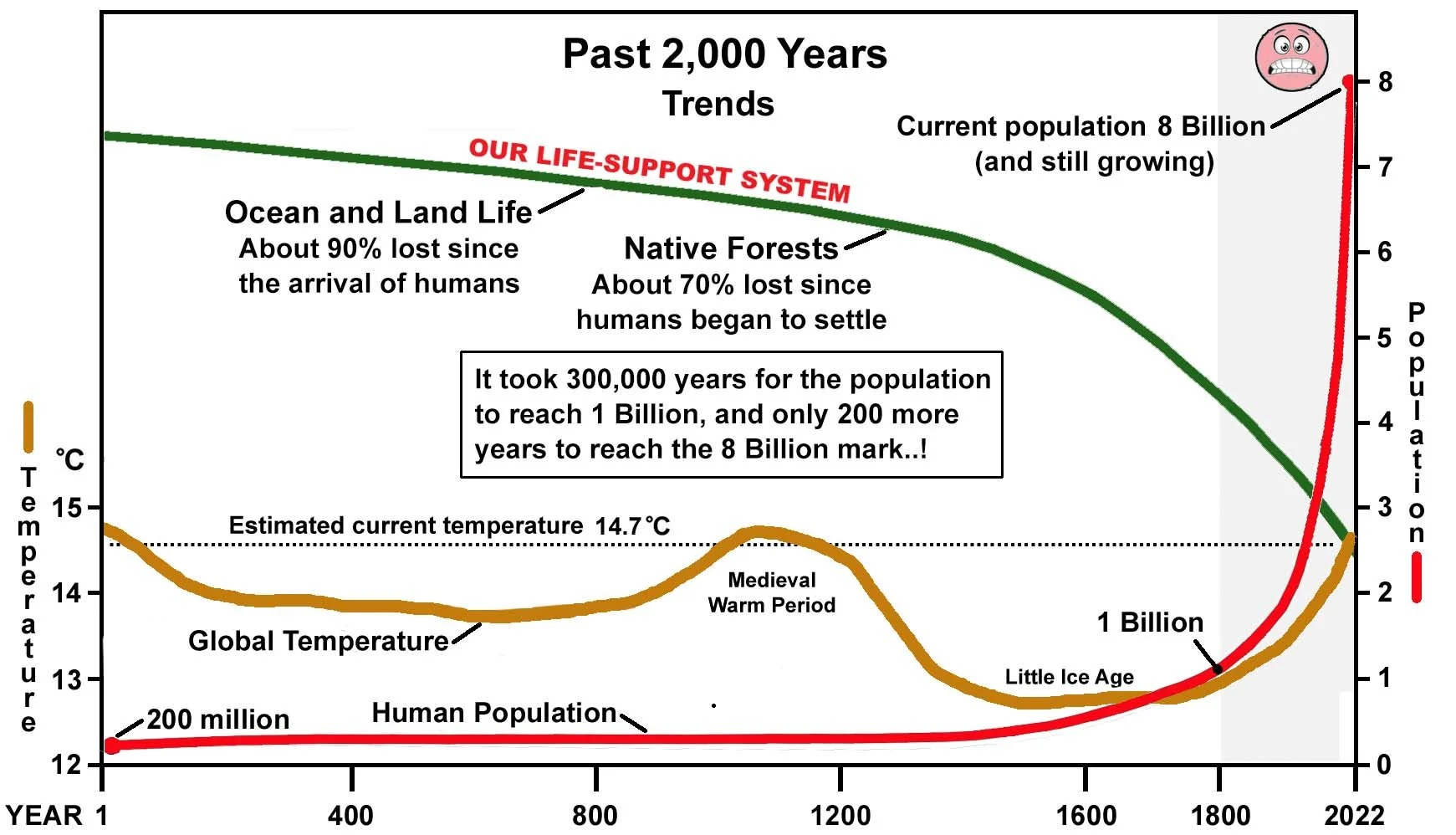
It’s worth pointing out that fossil-fuel-sourced fertilizers and fossil-fuel-run machinery played a major role in deforestation and “enabled” the population explosion – so the oil industry IS partly responsible for putting the health of our planet at risk, but it has nothing to do with carbon dioxide… And consider this, the only reason we can (barely) sustain today’s population IS because of fertilizers that come from fossil fuel...
Yes, it does seem that population growth is beginning to taper off – it’s a hopeful sign (although many will disagree), but it’s not nearly enough. If we want a truly sustainable, “balanced” ecosystem; if we want to save what’s left of other species; if we want a healthy, vibrant and diverse biosphere; if we want to reduce the risk of runaway warming; if we want humans all over the globe to have a shot at a peaceful, comfortable, enjoyable, satisfying life; then the only logical solution is to aim, not just for a leveling of the population, but for a gradual reduction.
We need to significantly reduce humankind’s impact on the planet..!
So, forget our “carbon footprint”, we should be concerned about our actual land footprint. And those who are still on the rickety carbon bandwagon can take comfort in the fact that population attrition would help reduce our carbon footprint as well. And this is not “disrespecting” life - on the contrary, if it allows us to improve the human condition and nurse the biosphere back to health, it’s honoring life - all life!
As a side note, I have to mention here the childish posts I’ve seen on social media claiming, for example, that “all of the 8 billion humans on earth today, standing shoulder to shoulder and chest to back, would fit in a space the size of New York city - so there’s obviously no overpopulation problem”. This is simply absurd - seems they have absolutely no idea how much space and resources are needed, and what impact that has on the planet, just to feed and house all those humans, let alone enjoy the modern conveniences we’re accustomed to.
Now remember, the planet has been gradually warming up for the past 20,000 years or so, and this will likely continue (with the occasional up or down swings). I do believe we could dampen the rise significantly by reclaiming a sizeable portion of our lost forests, but I doubt we can prevent it; there are forces at play that we have yet to fully understand. So, barring some major geological, solar or cosmic event that would cause a significant downturn in temperature, we have to get used to the idea and prepare for it... In the distant future, as the planet warms up and ocean levels continue to rise, we will need to gradually abandon low lying and equatorial regions and migrate to higher grounds and cooler latitudes, and we will lose some of our current arable lands. All this should be manageable, providing the planet is not overcrowded, and our ecosystem is healthy with enough “free” space for ALL species to adapt.
The UN lists 17 "Sustainable Development Goals" on its website, all laudable aspirations; but no suggestion anywhere that overpopulation might be a problem - seems it’s a taboo subject. Population control should be THE #1 goal - I believe it’s a prerequisite to reaching all the other goals on that list! Unfortunately, their own anti-carbon policies can only lead to standard of living decline and more poverty.
I know, “depopulation” is a VERY tough sell; even a slight decrease in population rattles the cage of most politicians, economists, financiers and businessmen. And aside from political and economic challenges, there are other issues such as the natural urge to procreate, family needs, traditions, cultural values, religious beliefs, etc. etc... So it has to be done “gently”, such as convincing the general public that smaller families are a good thing, and that having children is not necessarily for everyone.
The greatest challenge will be to convince those that have contributed the most to the “explosion” (Asia, the Middle East, India, and Africa) to “get on board” (graph - scroll over the graph for details; note that the last 75 years are projections); if they did, it would not only help improve the health of the planet, they would likely experience a significant positive impact on the wellbeing of their own citizenry as well. And we’re not talking euthanasia, enforced sterilization, compulsory birth control, or any such drastic measures - all that’s needed is a gradual change in social norms and a shift in priorities. And the so-called developed countries need to do their part by reducing their per-capita consumption and waste, while prioritizing quality of life rather than quantity of possessions.
Yes, the transition from a largely “growth-driven” pyramid economy to a more stable circular economy will likely be somewhat rocky, and we will have to re-think our approach to retirement and healthcare. But once past those hurdles, the system will stabilize. The free market (providing it’s allowed to function reasonably unhindered) will find solutions - the development of robotics and AI is a good start...
And let’s not forget the wealth and infrastructure that’s been accumulating over the decades; with a reduced population, that excess capital might actually create new opportunities. But that’s for economists and the free market to figure out. I believe that if we can get our act together, the human race could have an amazing and exciting future.
Healthy planet - Happy humans..!
Isn’t that what we should strive for… for every child on earth to have a good shot at a decent life on a beautiful, healthy, showcase planet..? In order to reach that goal, we need to start behaving less like Homo insipiens and a little more like Homo sapiens.
Here’s a thoughtful article from Scientific American on the desirability of “population decline”.
And what would be an ideal human population..? My best guess, for a planet our size and landmass (which will inevitably be gradually reduced by rising sea levels) is around 2-3 billion; that would mean returning to something near the 1960’s population levels. Yes, not easy, but much easier than relocating 8, 9 or 10 billion humans to some other planet, or facing extreme hardships...
Reducing our population would allow us to “reforest” no-longer needed spaces and low-yield farmlands, maybe even re-claim some deserts, allow the oceans to recover, and eventually reach a healthy balance between our consumption & lifestyle requirements and the rest of nature.
The conclusions of a recent study commissioned by The Club of Rome offers some glimmer of hope. Quote: “If current trends continue, the world population will reach a high of 8.8 billion before the middle of the century, then fall rapidly to 6 billion, far below United Nations’ estimates. This will allow humanity to focus on equality and well-being rather than on per-capita income growth. We simply cannot continue with ‘business as usual’ if we want our grand-children to live on a sustainable and equitable planet.”
There will be resistance, so it has to be done smartly, tactfully, and gradually. In democracies, it means first convincing the general public. Sadly, whole generations are now growing up in large cities, completely isolated from, and with little attachment to, the natural world; they’re more emotionally connected to the virtual world and man-made landscapes. Journalists, online “influencers”, educators, and dedicated organizations are on the front line; and they must put out the message. Politicians will only act they have voter support.
Supporting forest regeneration shouldn’t be a tough sell – it’s difficult to object to trees; and anti-carbon legislations could be quietly phased out. The real challenge is convincing the public that we’d be better off if there were a lot fewer of us - that goes against very strong cultural and emotional roadblocks…
Do we have what it takes..? Real change usually begins with some kind of “grassroots” movement. The first step is to get the conversation going - an open conversation - and it needs to start with social media… And scientists who may have been standing on the sidelines must gather their courage and get into the fray. The latest election results, both in the US and in Europe indicate the public may be ready for a change in direction…
Let’s put a smile back on her face…

On good days, I feel maybe we can pull it off - but then again, I’ve always been a bit of a dreamer…
This is my small contribution - one man’s point of view - hopefully palatable food for thought... Cheers!
JC
Comments? Use the form below…
________________________
Related links:
CLINTEL (CLImate INTELligence)
Scientists & Professionals are sending a message to politicians and the public
(note that all signatories are screened)
Currently over 2,000 signatories
Excellent documentary by John Robson,
Executive Director of Climate Discussion Nexus
World Hub for Forest Recovery Planning
“Your organization can make a real difference”
________________________
Note: This page is frequently updated
Comments, corrections, suggestions
All fields are optional